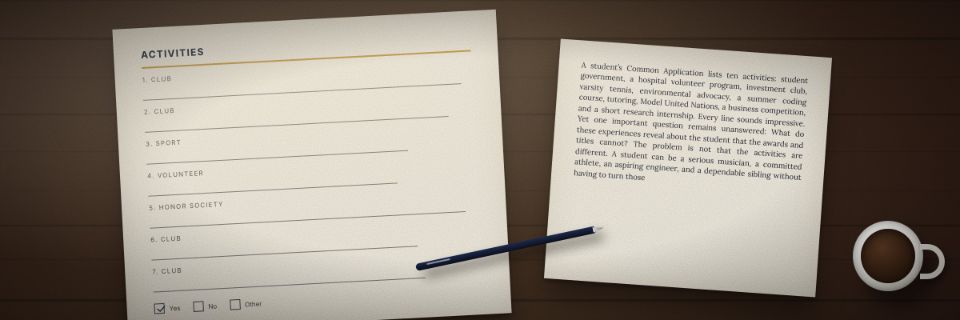
By the Beginning of Senior Year, Many Families Are Asking the Same Question: What Should My Child Write About?
They review the activity list, revisit summer programs, brainstorm personal statement topics, and try to identify the experience that will make the application memorable. But this process often starts too late. The student has plenty to say about what they have done, yet struggles to explain what connects their interests, what questions genuinely excite them, or what they want a college to understand about the way they think.
There is a better starting point: begin by understanding the student, not by choosing an essay topic.
At Scholar Coach, we use the idea of an intellectual brand as a planning framework: a working description of a student's academic interests, characteristic ways of investigating questions, and the problems or ideas they find meaningful. It is not a slogan to paste into an application. It is a hypothesis about what makes the student's intellectual life distinctive—one that should be tested against real experiences over time.
Starting this exploration in 10th or 11th grade can give students room to discover interests, pursue questions, and collect meaningful evidence before application deadlines arrive.
What Is an Intellectual Brand?
Think of an intellectual brand as the intersection of three elements:
The question: What subject, puzzle, or unresolved problem repeatedly captures the student's attention?
The method: How does the student naturally investigate it —through experiments, close reading, coding, argument, observation, mathematical modeling, or another approach?
The context: Where does the question matter, and what broader application, human experience, or intellectual debate makes it interesting?
These elements need not be fully developed or neatly aligned when a student begins. Their purpose is to generate better questions, not to produce a finished identity.
Consider a hypothetical student interested in both computer science and language.
“I'm interested in artificial intelligence” is a broad starting point. It tells us the field but little about the student's particular curiosity.
A more revealing question might be: Why do language models sometimes produce fluent answers that misunderstand the meaning of a sentence?
The student might investigate that question by comparing model outputs, studying ambiguity in linguistics, and examining how context changes interpretation. The broader significance could involve educational technology, translation, or communication.
Now we have a potential intellectual direction: the student is interested in how computational systems interpret human language and how those interpretations can fail.
That direction could inform course choices, independent exploration, conversations with teachers, and eventually some application writing. But it remains open to change. The student might discover that the real fascination lies in linguistics rather than artificial intelligence, or that a different question becomes more compelling.
The objective is not to choose a marketable label. It is to discover what the student actually wants to understand.
Why Start in 1 0 Th or 1 1 Th Grade?
A student who waits until senior year to think about intellectual identity may feel pressure to retrofit existing activities into a polished narrative. That pressure can encourage superficial connections and unnecessary résumé-building.
Starting earlier creates time for a different process:
Explore → notice patterns → investigate → reflect → revise. In 10th grade, a student might encounter an unexpected question in class, try a new activity, or discover that a favorite subject is more complicated than expected. In 11th grade, they might pursue the question through a project, a more advanced course, independent reading, a job, or a conversation with someone working in the field.
Some interests will deepen. Others will disappear. Both outcomes are useful.
This approach aligns with official admissions guidance. Yale describes intellectual initiative, critical thinking, curiosity, creativity, and a willingness to explore new horizons among the qualities it values. It also emphasizes that academic strength is central and that applicants are evaluated in the context of the opportunities available to them.
MIT makes a related point in its guidance on extracurricular activities: students should choose activities because they delight, intrigue, and challenge them, rather than because they believe those activities will look impressive. MIT also recognizes that students have different circumstances and responsibilities.
Neither university requires applicants to develop a formal intellectual brand. The framework is useful because it helps students explore their interests intentionally—not because it represents a hidden admissions requirement.
The Four-Step Intellectual Brand Mapping Exercise
Parents and students can begin with a simple exercise that takes a few conversations rather than a weekend of résumé engineering.
Step 1: Collect Questions, Not Achievements
Ask the student to identify five questions they have genuinely wondered about during the past year.
They might come from a class discussion, a novel, a research article, a part-time job, a personal experience, or an activity outside school.
Examples include:
Why do people continue believing an argument after its evidence has been challenged?
How can a medical test produce misleading results even when its measurements are accurate?
Why do some cities make public transportation more practical than others? How do mathematical models represent uncertainty?
Why does a translation preserve the literal meaning of a sentence but lose its emotional effect? These are starting points, not application topics. Encourage the student to explain what makes each question interesting and what they would want to investigate next.
If the student cannot explain why a question interests them beyond saying it sounds impressive, move on.
Step 2: Identify the Student’s Preferred Method of Thinking
Two students may care about the same topic but approach it differently.
Imagine two students interested in misinformation. One analyzes the language and rhetorical techniques used in misleading arguments. The other writes code to examine how information spreads through a network.
Their subject is similar; their methods differ.
Ask:
Do you prefer testing a hypothesis or interpreting an argument?
Do you learn by building something, reading deeply, debating, observing, or working with data? What kind of problem makes you want to keep going after an assignment ends?
When you encounter an unfamiliar question, what is the first thing you tend to do?
Students do not need one fixed method. The goal is to notice recurring habits that can help them choose worthwhile next steps.
Step 3: Look for Patterns Across Experiences
Now review the student's courses, assignments, activities, reading, and projects.
Do certain questions appear repeatedly? Does the student keep returning to a particular problem, even when it appears in different contexts? Are there moments when the student voluntarily pursued a question beyond the requirements?
For example, a student might have explored historical propaganda in an English paper, analyzed political rhetoric in debate, and examined the spread of misleading claims in a computer science project.
The connection may be an interest in how people evaluate information—not a requirement to pursue political science, English, and computer science as one unified academic identity.
The pattern is a hypothesis. Ask the student whether it feels accurate and whether it captures something they actually care about. If the connection feels forced, discard it.
Step 4: Find a Meaningful Next Question
A useful intellectual direction should create opportunities for further exploration.
Suppose the student is interested in how people interpret evidence. A next step could be to compare how different sources support competing claims, examine how statistical presentations affect interpretation, or study how language influences the perception of certainty.
The student does not need to launch a nonprofit, publish a paper, or solve a major societal problem. A thoughtful investigation that produces a clearer understanding may be enough.
The best next step is one the student has a genuine reason to pursue.
How the Map Should Shape the College Application
Once a student has a clearer understanding of their interests, the intellectual map can help organize the application. It should inform the student's choices without dictating every component.
The Activities List: Show What the Student Actually Did
An intellectual direction can help a student recognize which experiences deserve more explanation. But it should not lead them to inflate minor participation into major accomplishments.
Harvard's admissions guidance emphasizes the quality of activities and the student's contributions rather than the need to fill every available activity slot. It also considers work and family responsibilities meaningful parts of an applicant's life.
The practical question is: What did the student investigate, create, contribute, or learn? The answer matters more than whether the activity matches a predetermined theme.
Teacher Recommendations: Help Teachers Recall Real Examples
A teacher may be able to describe a student's intellectual curiosity through a classroom discussion, a paper, or a response to difficult feedback.
The intellectual map can help students identify which teachers have directly observed their interests and working habits. It can also help students provide concise reminders of specific assignments or moments.
But students should not ask teachers to repeat a branded narrative. A recommendation should reflect the teacher's own observations and judgment.
Essays: Reveal the Student’s Perspective
The personal statement does not need to explain the entire intellectual map.
Yale's essay guidance emphasizes that a student's perspective matters more than choosing an unusual topic. The university encourages applicants to write about meaningful experiences and interests in their own voices.
A student interested in computational linguistics might write about a moment when a translation failed to capture the meaning of a sentence. Another might write about an entirely different experience that reveals their curiosity, values, or relationships.
The subject should serve the story, not the other way around.
College Research: Investigate Genuine Academic Fit
A clearer intellectual direction can help students research departments, courses, research opportunities, and interdisciplinary programs more intelligently.
Instead of writing that a university is appealing because it offers computer science, the student can investigate whether the curriculum supports a question they genuinely want to pursue.
That does not mean every essay must name a professor or specialized course. Specific details are useful when they connect to real interests, not when they merely decorate the application.
Three Mistakes That Turn Intellectual Branding Into a Manufactured Persona
Mistake 1: Choosing the identity before understanding the student.
A parent decides that the student should be “the future AI ethicist” or “the young biomedical innovator,” then searches for activities that reinforce the label.
This reverses the process. Start with the student's real questions and experiences. Let a possible direction emerge from evidence.
Mistake 2: Forcing every activity into one narrative.
A student can love chemistry, play an instrument, work a part-time job, and spend weekends with family without all four experiences supporting a single academic thesis.
Coherence is useful when it reflects a genuine pattern. Artificial consistency makes a student's life look engineered.
Mistake 3: Treating the map as a contract.
Interests change. A student who begins in 10th grade interested in neuroscience might discover a stronger interest in philosophy, statistics, or public policy.
That is not a strategic failure. It is intellectual development. The map should be updated as the student's understanding changes.
How Scholar Coach Helps Students Map Their Intellectual Interests
Scholar Coach helps students identify the questions and working habits that make their academic experiences meaningful, then use those discoveries to make thoughtful decisions about the next stages of high school and college applications.
Conduct structured intellectual discovery. We explore favorite classes, memorable assignments, independent interests, difficult questions, and experiences the student chose to pursue without being required to do so.
Identify recurring patterns. We look for genuine connections among the student's questions, methods, and experiences while preserving interests that do not fit neatly into one theme.
Plan appropriate next steps. We help students choose courses, reading, projects, activities, or conversations that deepen their understanding without manufacturing résumé items or adding unnecessary commitments.
Build an evidence-based application narrative. We help students determine which experiences demonstrate their interests and contributions, which teachers can speak to them firsthand, and which essay topics reveal a meaningful perspective.
Revisit the map as the student grows. We treat the intellectual direction as a working hypothesis, not a fixed brand. New discoveries can refine or replace it.
The purpose is not to make a 16-year-old sound like a finished academic professional. It is to give the student time to become more curious, more reflective, and more capable of explaining what matters to them.
Start with the Question, Not the Slogan
A strong college application does not require a perfectly unified intellectual identity, a world-changing project, or a predetermined career plan.
It benefits from a student who can describe what interests them, show how they have explored those interests, and reflect honestly on what they have learned.
Beginning in 10th or 11th grade makes that exploration less rushed. The student has time to follow a question, discover that an assumption was wrong, change direction, and develop a clearer understanding of their own mind.
The final application may reveal a recognizable intellectual thread. It may also reveal a curious student whose interests span several fields. Both can be authentic.
The most useful question to ask your child today is not, “What will your college application be about?”
Ask instead: “What is something you keep wondering about, even when nobody is asking you to study it?”
That is a much better place to begin.