A teacher writes that a student is “an extraordinary intellectual force whose interdisciplinary curiosity transforms every academic environment.” The sentence sounds impressive. But what did the teacher actually observe? Did the student ask an unusually perceptive question, help classmates understand a difficult concept, or pursue an idea beyond the assignment? Without that context, the praise tells an admissions reader relatively little.
A recommendation letter has a job that the student's résumé and essays cannot perform as effectively: it offers another person's firsthand perspective. The teacher has seen the student think, struggle, participate, respond to feedback, and interact with classmates. That perspective is valuable precisely because it comes from someone who has observed the student in a different setting.
The challenge for families is to help teachers write informed recommendations without turning those recommendations into another piece of student marketing.
Yale's admissions office explicitly states that specific, thoughtful discussions of a student's strengths are more useful than generic superlatives. The Common App's guidance similarly emphasizes the value of teachers' firsthand knowledge of intellectual curiosity, creative thought, classroom behavior, and work habits.
Neither source provides a universal method for detecting coached letters. The more useful lesson is that a recommendation becomes more informative when its claims are supported by real observations—and less informative when it merely repeats information already available elsewhere.
Sources: Yale Admissions: Recommendation Letters; Common App: Writing Guide for Counselors and Teachers.
1. Specific Observations Matter More Than Impressive Vocabulary
Parents sometimes assume that a recommendation must sound sophisticated to be persuasive. They may worry that a teacher's straightforward writing will compare poorly with a letter full of polished adjectives, elaborate phrasing, or claims of exceptional ability.
Admissions guidance suggests a different priority: evidence.
MIT Admissions asks recommenders to support their conclusions with facts and anecdotes whenever possible. Its published examples contrast a detailed letter that reveals how a student thinks and acts with positive but generic praise that provides little insight into the applicant.
The distinction is easy to see.
Generic praise: “She is an exceptionally dedicated student with outstanding analytical abilities and an extraordinary work ethic.”
Specific observation: “During our unit on probability, she challenged an assumption in a worked example, explained why the conclusion did not follow, and revised her own solution after a classmate identified a different error.”
The second example gives the reader something concrete to evaluate. It illustrates the student's reasoning, classroom engagement, and response to another person's contribution.
A teacher need not write a dramatic anecdote in every paragraph. A small, accurate observation can be more revealing than a sweeping claim about the student's potential.
This also explains why unusual vocabulary is not the central issue. A teacher may naturally write in an elegant, formal style; another may prefer plain language. Neither style establishes authenticity by itself. The more meaningful question is whether the letter's claims reflect what the teacher knows about the student.
Source: MIT Admissions: How to Write Good Letters of Recommendation.
2. A Recommendation Should Add a Perspective the Application Cannot Supply
A student's application already contains grades, activities, awards, essays, and descriptions of accomplishments. A recommendation can confirm some of that information, but its distinctive value comes from showing how the student behaves and develops in an environment the recommender has personally observed.
Yale advises applicants to choose teachers who know them well and can discuss the substance of their intellect and character. It also explains that the most useful additional recommendations provide new information and dimension rather than repeating strengths already described elsewhere.
The Common App makes a similar distinction between the teacher's classroom perspective and the counselor's broader view of the student within the school community.
For a teacher, useful observations might include:
How a student approaches a difficult or unfamiliar problem.
Whether the student asks questions that extend beyond the immediate assignment.
How the student responds when feedback reveals a weakness.
Whether the student helps peers understand difficult material. How the student's work, participation, or intellectual confidence develops over time.
These details need not be extraordinary in isolation. Their value lies in what they reveal about the student as a learner. Imagine that an application describes a student as passionate about biology. A teacher who has observed the student in class might explain how that interest appeared during a laboratory investigation, how the student handled an unexpected result, or how the student revised an explanation after reviewing the evidence.
The teacher is not simply repeating the student's stated interest. The letter gives the reader an independent view of how that interest manifests itself.
A family should therefore resist the temptation to make every recommendation mirror the student's central application theme. A coherent application does not require every contributor to tell the same story. Different perspectives can create a fuller picture of the applicant.
Sources: Yale Admissions: Recommendation Letters; Common App: Writing Guide for Counselors and Teachers.
3. Why a Teacher’s Honest Voice Is More Valuable Than a Script
A recommendation letter is written by the recommender, not by the family or the student's admissions consultant. That distinction is not merely procedural. It protects the letter's value as an independent assessment.
Consider the difference between helping a teacher remember a student's accomplishments and handing the teacher a finished paragraph to copy.
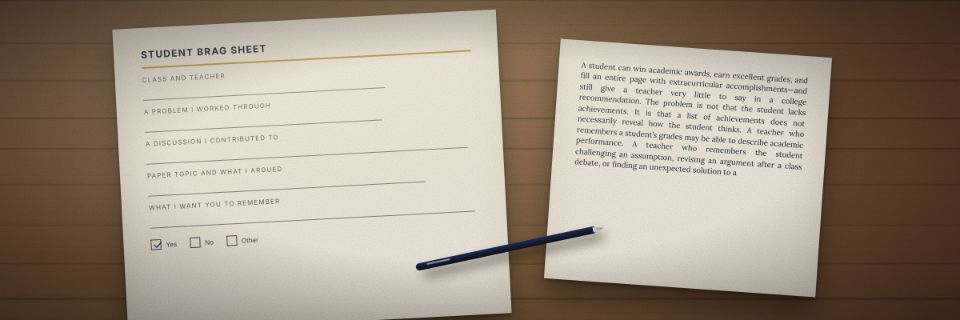
A student might provide a brief list of relevant experiences: a research project completed in the teacher's class, a major revision to an essay, or a question that led to further investigation. This gives the teacher useful reminders, especially when the teacher has many students to write about.
But a prewritten paragraph that dictates how the teacher should characterize the student's intellectual abilities, personality, or comparative standing crosses a different line. It asks the recommender to adopt an evaluation that may not reflect the teacher's own judgment.
The risk is not that every polished phrase will trigger suspicion. There is no publicly established vocabulary test that admissions officers use to identify consultant involvement. Rather, scripting can replace the very thing the recommendation is supposed to provide: the teacher's own assessment.
It can also produce a practical problem. A teacher who has been given a polished description of a student's achievements may end up repeating the same language used in the student's essays or activities list, leaving the admissions reader with little new information.
MIT's recommendation guidance is instructive because it explicitly asks teachers to write honestly, in a way that feels comfortable to them, and to explain the basis for their impressions. That is a better standard than trying to imitate a supposedly ideal admissions-reader voice.
Source: MIT Admissions: How to Write Good Letters of Recommendation.
4. The Parent’s Role: Supply Context, Not a Performance
Parents often know details that a teacher may not: a student's long-term interests, outside responsibilities, independent projects, or the circumstances behind a particular accomplishment. Sharing relevant information can be helpful, especially when a school asks families to complete a questionnaire.
The Common App provides resources for gathering information from students and families, including questionnaires that can help recommenders develop a more personalized understanding of an applicant. This is a legitimate way to supply context without dictating the content of a letter.
The boundary is straightforward.
Helpful information includes:
A concise summary of significant activities or accomplishments the teacher may not know about.
Dates, roles, or project details that help the teacher recall a particular experience.
Context about a major academic development or unusual circumstance, when relevant. A student's own reflections on what they learned, which the teacher can consider independently.
Unhelpful direction includes:
Asking the teacher to use specific adjectives or claim that the student is among the best they have ever taught.
Providing a finished letter or paragraph and expecting the teacher to submit it as their own.
Pressuring the teacher to describe an accomplishment they did not witness or cannot independently assess.
Repeatedly requesting revisions because the letter does not match the family's preferred admissions narrative.
The distinction is between supplying accurate information and controlling the evaluation.
A teacher may decide that a student's strongest quality is intellectual curiosity, while the family believes leadership should be emphasized. The teacher's judgment deserves room to stand. An independent recommendation is not supposed to function as a customized advertisement.
Source: Common App: Recommender Guide.
5. Choose the Right Recommender Instead of Trying to Engineer the Letter
The most useful recommendation does not necessarily come from the teacher who awarded the student the highest grade or taught the most advanced class. It often comes from someone who can describe the student with enough firsthand knowledge to make a meaningful assessment.
MIT recommends choosing teachers who know the applicant as both a student and a person, rather than someone who can speak only to test performance. Yale likewise emphasizes selecting teachers who know the student well and can discuss the substance of their intellect and character.
Before asking a teacher, students should consider:
Depth of interaction: Has the teacher seen the student think, work, participate, or develop over time? Specific knowledge: Can the teacher recall particular examples rather than rely entirely on grades?
Academic perspective: Can the teacher describe the student's approach to the subject and readiness for further study?
Willingness: Is the teacher genuinely comfortable writing a supportive recommendation?
Students should ask politely and early, provide the information the school or teacher requests, and allow adequate time. If a teacher does not feel able to write a strong letter, it is better to know that before the deadline than to pressure the teacher into making unsupported claims.
Families should also check each college's requirements before adding extra recommendations. More letters do not automatically create a stronger application. Yale, for example, notes that additional recommendations are most useful when they provide new information and dimension.
How Scholar Coach Helps Families Navigate Recommendation Letters
Scholar Coach helps families coordinate the recommendation process while preserving the teacher's independent voice.
Identify appropriate recommenders. We help students consider which teachers have firsthand knowledge of their academic work, intellectual development, and classroom contributions.
Prepare concise background materials. We organize relevant projects, experiences, accomplishments, and reflections into factual summaries that help teachers recall important context without scripting their evaluations.
Clarify the purpose of each letter. We help families understand how teacher, counselor, and optional additional recommendations can contribute different perspectives, subject to each college's requirements.
Avoid unnecessary repetition. We review the application as a whole so that essays, activity descriptions, and recommendations can complement one another rather than repeat the same claims.
Keep the process professional. We help students make timely requests, communicate respectfully, and follow application procedures without pressuring teachers to adopt language or conclusions that are not their own.
A compelling recommendation does not need to sound like a marketing campaign. It needs to give the admissions reader a credible view of a real student, observed by someone who can explain what makes that student distinctive. The family's job is to make that account easier to write—not to write it on the teacher's behalf.