A teacher writes: “Maya is polite, hardworking, punctual, and respectful. She completes her assignments on time and maintains excellent grades.”
Every sentence may be true. Yet after reading the paragraph, an admissions officer still knows very little about Maya's intellectual life.
What questions does she ask when the material becomes difficult? Does she reconsider her reasoning when the evidence contradicts her first answer? Does she help classmates understand challenging concepts? What, specifically, makes her stand out among other students who also earn excellent grades?
That is the difference between a positive character reference and a compelling academic recommendation.
Yale Undergraduate Admissions explains that recommendations help readers understand how students think and learn, contribute to their school communities, and affect classroom dynamics. Yale also emphasizes that specific discussions are more useful than strings of generic superlatives. MIT similarly encourages teachers to go beyond grades and academic performance, using concrete stories to reveal qualities that other parts of the application cannot show.
The goal is not to make every teacher write a dramatic endorsement. It is to help teachers recognize and describe the most meaningful evidence they have about a student's academic promise.
1. “Good Student” Is a Starting Point, Not a Finished Recommendation
Reliability, politeness, and punctuality are worthwhile qualities. They can matter to teachers and future classmates alike. The problem arises when these qualities replace discussion of the student's intellectual work.
Consider two descriptions of the same hypothetical student.
The Generic Version
“Daniel is an outstanding student who consistently earns high grades. He is diligent, respectful, and always prepared for class. He is a pleasure to teach, and I am confident he will succeed in college.”
The Evidence-Based Version
“Daniel consistently performed at a high level in calculus, but what distinguished him was his approach to unfamiliar problems. During our unit on integration, he questioned why two methods that appeared different could produce equivalent results. He tested the approaches against several examples, then explained the connection to classmates who had been treating them as unrelated procedures.”
The second version still communicates academic strength, but it adds a specific observation. It shows the student engaging with an idea, investigating a question, and helping others understand the result.
A teacher does not need to invent an extraordinary classroom moment. A real example of thoughtful questioning or careful reasoning can be more informative than a paragraph filled with adjectives.
The practical test is simple: Could the same paragraph describe almost any successful student in the class? If so, the teacher may need to add a more specific example.
2. What Makes an Academic Recommendation Convincing?
A strong recommendation generally combines three elements: context, evidence, and interpretation.
Context establishes how the teacher knows the student. Which course did the student take? At what level? For how long? What opportunities did the teacher have to observe their work?
Evidence describes something the teacher actually saw: an unusual question, a carefully developed argument, a response to criticism, a demanding project, or a contribution to a group.
Interpretation explains why that observation matters. Did the student demonstrate unusual independence for their level? Did they respond to a difficult concept with persistence? Did they help a class discussion become more rigorous?
The College Board's teacher recommendation guidance describes recommendations as honest assessments of academic performance and intellectual promise. It encourages specific anecdotes that help admissions committees understand the student beyond grades and test scores.
This framework helps distinguish a meaningful claim from an unsupported one.
Compare:
“She is intellectually curious.”
“She regularly asked how the assumptions behind our model affected its conclusions.”
“During our economics unit, she compared two models that produced different predictions and asked what evidence would help determine which assumptions were more appropriate.”
Each statement adds detail. The third gives the reader a specific episode and a question the student pursued. If the teacher genuinely observed it, the example supports a more informed assessment of the student's curiosity.
The strongest letter does not necessarily contain the most elaborate story. It contains enough accurate detail for the reader to understand the teacher's judgment.
3. The Five Qualities Worth Helping Teachers Remember
Students should not ask teachers to use particular adjectives. They can, however, reflect on experiences that might help a teacher describe their strengths more precisely.
Intellectual Initiative
Does the Student Pursue a Question Beyond the Minimum Requirements?
A teacher might recall a student who investigated an alternative solution after completing a mathematics assignment, researched a historical source that complicated a class discussion, or independently tested a coding idea introduced during a lesson.
The important detail is not simply that the student did extra work. It is what motivated the exploration and what the student did with it.
Original Thinking
Does the Student Make a Meaningful Connection, Question an Assumption, or Develop an Interpretation of Their Own?
Original thinking does not require inventing a new scientific theory. It may involve noticing an overlooked detail in a literary passage, proposing an alternative explanation for an experimental result, or finding a different way to approach a proof.
A recommendation should describe the actual contribution rather than labeling every independent thought “innovative.”
Response to Difficulty
A useful example might show the student identifying a gap in their reasoning, seeking feedback, testing a different approach, or revising an argument after discovering contradictory evidence.
What Happens When the Student Does Not Immediately Understand the Material?
The purpose is not to manufacture a story of failure and triumph. It is to reveal how the student learns when success is not immediate.
Contribution to Classmates
Does the Student Improve the Learning Environment for Others?
A teacher might describe a student who clarified a difficult concept for a peer, asked a question that prompted a more substantial discussion, or helped a group distinguish between competing explanations.
The best example identifies what the student did and how others responded. It need not claim that the student transformed the entire classroom.
Intellectual Growth
Has the Student Developed Greater Independence, Precision, or Sophistication Over Time?
Perhaps early essays summarized the material while later essays evaluated competing interpretations. Perhaps a student who initially relied on familiar procedures learned to justify each step of a proof. Perhaps class discussions became more analytical as the student learned to support claims with evidence.
Growth can be particularly revealing because it shows the teacher's firsthand perspective on how the student developed.
The Common App's teacher and counselor writing guide identifies intellectual engagement, approaches to assignments, reactions to challenges, contributions to peers, and development over time as useful areas for recommendations.
4. What About Comparisons to College Students or Other Top Applicants?
A comparison can strengthen a letter when it reflects a teacher's genuine experience and is supported by a meaningful basis for comparison. But students should not ask teachers to compare them to college undergraduates simply because the phrase sounds impressive.
A credible comparison might explain that a student demonstrated a level of independence unusual among students the teacher has taught in a particular course. A teacher who has taught the subject for many years may also be able to make a meaningful comparison across graduating classes.
The comparison should be specific enough to interpret.
“Among the strongest students I have taught in twenty years” is more informative if the teacher explains what made the student's work exceptional. Did the student develop an unusually rigorous proof? Conduct a sophisticated analysis? Demonstrate remarkable independence in a research project?
Without that context, even an impressive ranking can feel detached from the actual evidence.
Likewise, a teacher should not claim that a student performs at the level of a college undergraduate unless the teacher has a reasonable basis for that judgment. College-level work varies widely, and completing an advanced high school assignment does not automatically establish equivalence.
The better strategy is to help the teacher remember the work, not request a superlative. If a strong comparison is justified, the teacher can make it independently and explain its basis.
5. How to Help a Teacher Write a More Specific Letter
Students cannot control the content of a recommendation, and they should not try to dictate it. They can make it easier for a teacher to recall relevant experiences.
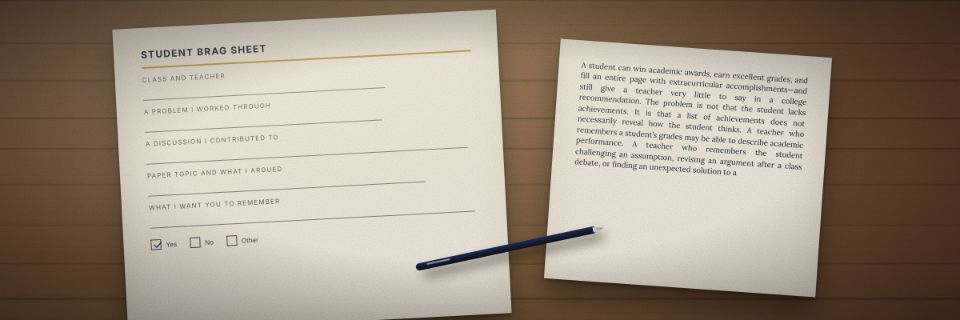
A short brag sheet can include three or four prompts:
A question I pursued: What question did I ask in class or after class that reflected a genuine interest? A challenging assignment: Which paper, proof, experiment, or project best represents how I approach difficult work?
A moment of growth: When did I revise my reasoning, incorporate feedback, or develop a more sophisticated approach?
A contribution to others: When did I help a classmate understand an idea or contribute to a productive discussion? For each answer, include the context, your individual contribution, and what you learned. Avoid writing the teacher's intended conclusion.
For example, instead of writing, “Please describe me as an exceptionally original thinker,” a student might write:
“During our unit on probability, I became interested in why two approaches to the same problem produced different intermediate results. I compared the assumptions behind each method and asked about the conditions under which they were equivalent. I included the problem here in case it helps you remember the discussion.”
The teacher can decide whether the interaction is worth discussing and how to characterize it. They may remember another example that better reflects the student's strengths.
MIT's recommendation guidance encourages teachers to describe intellectual risk-taking and experiences that go beyond normal classroom expectations. It also emphasizes that the letter should provide information unavailable from grades alone.
6. Build the Relationship Before the Recommendation Request
A brag sheet cannot substitute for a genuine teacher-student relationship. It can remind a teacher of experiences, but it cannot create firsthand knowledge that never existed.
Students who want strong recommendations should focus on meaningful engagement throughout the course:
Ask questions because they want to understand the material, not because they want to be noticed.
Participate thoughtfully in discussions and listen when classmates offer different interpretations. Seek feedback on work they genuinely want to improve.
Follow up when a concept remains unclear.
Show intellectual development across assignments rather than concentrating all effort on a single impressive submission.
Treat teachers respectfully and allow them to make independent judgments.
These habits are valuable even if the teacher never writes a recommendation. They improve learning and help teachers develop a more accurate understanding of the student.
When it is time to request a letter, students should ask early and give the teacher a comfortable opportunity to decline if they cannot write a strong recommendation. A teacher who knows the student well and can describe their work in detail may be a better choice than a teacher who assigned a higher grade but had little meaningful interaction with them.
Yale explicitly advises applicants to choose teachers who know them well and can discuss the substance of their intellect and character, rather than selecting solely based on the highest grade earned.
7. A Simple Test for a Strong Recommendation
Before requesting a letter, students can reflect on the following questions:
Can this teacher describe how I approach a difficult idea?
Have they seen me ask a question, revise an argument, or investigate something beyond the assignment?
Can they provide a specific example of my work rather than only describe my personality? Have they observed how I contribute to classmates or classroom discussions?
Can they explain something meaningful about my development over time?
Will their letter add a perspective that my transcript, activities list, and essays do not already provide?
Not every teacher will have an equally strong example for every question. A letter can be effective by focusing on a few qualities the teacher has genuinely observed.
The objective is not to turn every recommendation into a dramatic endorsement. It is to ensure that the teacher has a reasoned basis for the assessment they offer.
How Scholar Coach Helps Students Prepare for Stronger Teacher Recommendations
Scholar Coach helps students identify the academic experiences that teachers can credibly describe, then organize those experiences into concise reminders.
1. Identify the most revealing academic moments. We look beyond grades and awards to specific questions, projects, revisions, and discussions that reveal how the student thinks.
2. Turn vague self-descriptions into evidence. Instead of relying on claims such as “I am hardworking” or “I am intellectually curious,” students identify experiences that support those descriptions.
3. Prepare a concise, teacher-specific brag sheet. We help students select a few relevant examples for each recommender rather than distributing the same generic résumé to every teacher.
4. Identify the right recommenders. We help students consider which teachers have firsthand knowledge of their academic work, intellectual development, and contributions to the classroom.
5. Preserve the teacher's independent voice. We help students share accurate context and useful reminders without scripting the letter, dictating superlatives, or asking teachers to make claims they cannot support.
A teacher does not need to call a student a future genius to write a powerful recommendation. They need to explain what they observed, why it mattered, and what it reveals about the student's potential.
“Polite, hardworking, and punctual” may be true. But when a teacher can also describe the question that challenged a student's assumptions, the revision that improved an argument, or the explanation that helped a classmate finally understand a difficult concept, the letter becomes more than a character reference.
It becomes an informed account of a student who is ready to keep learning.