A student tells a college that they want to study computational linguistics. Their application describes an interest in how language works, how computers process meaning, and why automated systems struggle with ambiguity.
Their mathematics teacher writes that they are hardworking and earned an A. Their English teacher calls them an excellent writer. Both recommendations are positive. Neither explains how the student's interests connect to the intellectual work they hope to pursue.
Now imagine that the English teacher recalls the student's habit of questioning ambiguous wording, while the mathematics teacher describes how they approached a logic problem by testing the assumptions behind different solutions. Neither teacher needs to call the student a future computational linguist. Together, their observations may help readers understand the student's academic interests from two distinct perspectives.
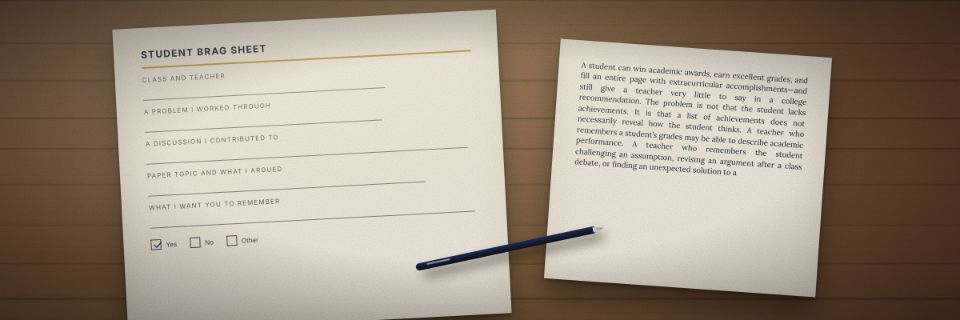
That is the purpose of an academically aligned brag sheet: not to make every recommender repeat the intended major, but to help each teacher identify relevant, firsthand evidence that might otherwise be overlooked.
Yale explains that recommendations help admissions readers understand how applicants think and learn, how they contribute to their school communities, and what they add to classroom dynamics. Penn likewise emphasizes specific observations that reveal information beyond grades and scores. Neither institution describes recommendations as a requirement to validate a student's declared major. Their guidance supports a more useful principle: recommendations should add credible evidence to the larger picture of the applicant.
1. Build a Coherent Application Without Making Every Document Say the Same Thing
A college application contains different kinds of evidence. A transcript documents coursework and academic performance. Essays explain the student's interests, experiences, and goals. Activities and project descriptions show what the student has pursued. Recommendations provide another person's perspective on the student's abilities, character, and development.
These components can reinforce one another without repeating the same claims.
Consider a student applying to study computer science.
Essay: Explains why the student became interested in how algorithms classify information.
Activities list: Documents a programming project and the student's actual role.
Mathematics recommendation: Describes how the student reasons through unfamiliar problems.
English recommendation: Describes how the student interprets language carefully or constructs precise arguments.
The recommendations do not need to mention computer science explicitly. If the teachers have genuinely observed these habits, their letters can provide relevant context for the student's stated interests.
This distinction matters because academic alignment is not the same as keyword alignment. Repeating “computer science,” “research,” or “interdisciplinary thinking” does not establish readiness for a field. Specific evidence of the student's reasoning, questions, and work is more informative.
A student should not expect every part of the application to support a single polished identity, either. Real academic interests can be broad, evolving, and interdisciplinary. The objective is to make the student's development understandable—not to force every experience into one predetermined narrative.
2. Start with the Academic Question, Not the Major Label
Before filling out a brag sheet, students should identify what genuinely interests them about their intended field.
“I want to study biology” is a field of study. “I want to understand how changes in gene regulation influence disease progression” identifies a more specific question. A student need not have advanced research experience to express such curiosity, and the question may change as they learn more.
The next step is to identify the actual experiences that reveal this interest.
Intended Field
A More Revealing Academic Interest
Evidence a Recommender Might Discuss
Computer Science
How can an algorithm fail when the input differs from the examples it was designed around?
Testing edge cases, debugging, or questioning assumptions in a programming assignment.
Computational Linguistics
How Does a Computer Distinguish Between Multiple Meanings of the Same Sentence?
Careful analysis of ambiguous language, a language-related coding project, or questions about how meaning is represented.
Biomedical Engineering
How can a device be designed around the needs and limitations of its users?
Iterative design, testing, or thoughtful consideration of constraints during a technical project.
Economics
How Do Assumptions About Human Behavior Affect the Conclusions of a Model?
Comparing models, questioning assumptions, or interpreting evidence in a mathematics or economics class.
History
How can conflicting sources change our understanding of an event?
Evaluating primary sources, revising a thesis, or distinguishing evidence from interpretation.
These examples are prompts for reflection, not a checklist of achievements every applicant needs. A student interested in computational linguistics does not need to have built a sophisticated language model. A teacher who has observed the student's careful reasoning about syntax or meaning may have a relevant example, provided the connection is genuine.
The question to ask is: What have I actually done, asked, or explored that helps explain why this field interests me?
3. Match Each Recommender to the Evidence They Can Honestly Provide
One of the most common mistakes in application planning is assuming that the teacher of the intended major must write the strongest recommendation.
Subject expertise can be relevant, but familiarity with the student's work matters too. MIT explicitly advises applicants that they do not need to choose a teacher solely because that teacher teaches their intended major. Its recommendation guidance emphasizes teachers who know the student beyond test performance.
Imagine a student interested in computational linguistics who has taken advanced mathematics and English.
The mathematics teacher may be able to discuss how the student approaches formal reasoning, recognizes patterns, or tests a proof. The English teacher may be able to describe how the student analyzes syntax, distinguishes competing interpretations, or revises an argument after encountering contradictory evidence.
Both perspectives could be relevant. Neither teacher should be asked to claim expertise in computational linguistics or endorse a project they have not observed.
A practical way to evaluate possible recommenders is to ask:
Which teacher has seen me work through difficult or unfamiliar material? Who can describe a specific question, assignment, or interaction rather than relying on general praise? Which teacher can speak to an aspect of my academic development that other application materials do not already explain?
What Can This Teacher Credibly Say From Firsthand Experience?
The strongest combination is not necessarily two letters that confirm the same trait. Two distinct, credible perspectives can provide a more complete picture.
4. Use the Brag Sheet to Connect Interests with Observable Behavior
A useful brag sheet gives a teacher enough context to remember relevant experiences without telling them what conclusion to reach.
For each potentially useful example, students can provide four details:
Context: What class, assignment, discussion, or project was involved? Question: What problem or idea interested you?
Action: What did you do, test, question, or revise?
Reflection: What did the experience teach you or make you curious about next?
Consider a student who wants to study computational linguistics. Weak brag-sheet entry:
“I am passionate about artificial intelligence and language. I want to combine computer science and linguistics in college.”
This states an interest, but gives the teacher little to recall or evaluate.
More useful entry:
“During our unit on sentence structure, I became interested in how the same sequence of words could be interpreted differently depending on context. I started collecting examples of ambiguous sentences and comparing the interpretations. That made me curious about how a computational system might represent more than one possible meaning.”
This entry provides a classroom context, a specific question, and a follow-up interest. If the teacher remembers the discussion or has observed the student's analysis, they can decide whether it belongs in the recommendation.
The student should not claim that this activity proves readiness for advanced computational research. It provides evidence of a developing interest and a way of thinking. The recommender can describe what they observed; the student can explain the broader significance in an essay.
5. Ask Questions That Help Teachers Recall the Right Details
A brag sheet becomes more useful when its prompts reflect the teacher's experience with the student.
Instead of asking, “Can you mention my interest in computational linguistics?” a student might write:
For a mathematics teacher: “I remember struggling with the proof in our unit on logic and trying a different approach after my original argument failed. If you recall that assignment, I would appreciate your perspective on how I approached the problem.”
For an English teacher: “Our discussion of ambiguous language made me curious about how meaning depends on structure and context. I included a few examples in my notes afterward. If you remember that discussion, it may help you recall the kinds of questions I enjoy exploring.”
For a science teacher: “During the lab project, I was interested in why our result differed from our initial prediction. I reviewed the assumptions behind our procedure and revised my explanation. I would value your perspective on that process if it stands out to you.”
Notice the wording: “if you recall” and “if it stands out to you.” These phrases leave room for the teacher's own memory and judgment. The student is offering context, not asking for a predetermined endorsement.
The College Board's guidance for teacher recommendations specifically recommends giving teachers information about a student's goals and interests, along with an interaction sheet or examples of past assignments to help them recall relevant experiences. This is a practical use of a brag sheet: making real experiences easier to remember.
6. Do Not Ask Teachers to Validate What They Have Not Seen
Academic alignment can become counterproductive when students try to orchestrate every component of their application.
Suppose a student describes an independent machine-learning project in an essay. Their teacher has never seen the code, discussed the methodology, or observed the student's work on it. The student should not ask that teacher to certify the project's sophistication or claim that it demonstrates advanced technical ability.
The teacher may be able to discuss related qualities they have observed in class, such as logical reasoning, persistence, or willingness to investigate a question. The project itself should be described through the student's own application materials or by a mentor who can accurately assess it.
This boundary protects the credibility of the recommendation. Penn's official guidance emphasizes that recommenders should write from firsthand knowledge and avoid repeating claims they cannot verify.
It also prevents a subtler problem: making the application sound artificially coordinated. If every letter repeats the same terminology and the same account of the student's ambitions, the reader may learn little that is new.
A teacher's independent observation is valuable precisely because it is not simply another version of the student's self-description.
7. A Practical Academic-Alignment Brag Sheet
Students can use the following worksheet before requesting recommendations or meeting with teachers.
My intended academic direction: What field or combination of fields am I considering? How certain am I that this is the right description of my interests?
The Question Behind the Interest: What Do I Genuinely Want to Understand, Build, Analyze, or Investigate?
Evidence from coursework: Which assignment, discussion, proof, experiment, or paper reflects how I approach this kind of question?
Independent exploration: Have I pursued the interest beyond class? What did I actually do, and what was my individual contribution?
The relevant teacher: Which teacher has firsthand knowledge of this work or of a related intellectual habit?
The Specific Memory: What Interaction or Assignment Might Help the Teacher Recall My Approach?
What the teacher can independently confirm: Which details are based on the teacher's direct observation, and which are simply my own interpretation?
What the rest of the application already covers: Is there something genuinely new that this teacher could contribute, or am I asking the letter to repeat my essay?
Students do not need to answer every question with a major project. An insightful classroom discussion, a revised argument, or a carefully reasoned solution can be valuable when it reflects genuine intellectual engagement.
Nor should students worry if their interests span multiple fields. An application can show a coherent trajectory without pretending that every academic experience points toward one narrow specialization.
How Scholar Coach Helps Students Prepare Academically Aligned Brag Sheets
Scholar Coach helps students organize their academic experiences so that their essays, projects, and recommendations can contribute distinct, credible perspectives.
1. Clarify the academic direction. We help students move beyond a major label to identify the questions, problems, or methods that genuinely interest them.
2. Map real experiences to those interests. We identify relevant coursework, independent projects, research, and classroom discussions without overstating what any experience proves.
3. Match evidence to the recommender. We help students identify which teachers can speak credibly about their reasoning, writing, technical work, or intellectual development.
4. Prepare concise, teacher-specific reminders. Students organize a few relevant examples and questions to jog the teacher's memory without scripting the letter.
5. Check for complementarity, not repetition. We review how the recommendation fits with the student's other materials, looking for useful additional evidence rather than forcing every component to repeat the same narrative.
The goal is not to engineer a unanimous endorsement of a student's intended major. It is to help admissions readers see a credible connection between what the student says they want to study and the intellectual habits they have begun to demonstrate.
A student interested in computational linguistics may show that interest through language analysis, formal reasoning, and independent technical exploration. Another student may demonstrate a similar academic direction through a different path. The evidence does not have to look identical.
The strongest brag sheet gives each teacher a chance to contribute what they know firsthand. When those perspectives complement the student's essays and activities, the application can become more coherent without becoming rehearsed.