Two students apply to similarly selective colleges. Both have strong grades, demanding coursework, and meaningful extracurricular involvement.
One attends a private school where the college counselor has worked closely with a small graduating class. The other attends a large public high school, where the counselor manages a substantial caseload alongside transcripts, graduation requirements, scheduling, and other responsibilities.
The second student's counselor may know less about the student's individual intellectual interests, personal circumstances, and contributions to the school community. That does not mean the counselor will write a weak letter. It does mean the student should not assume that the counselor already knows every detail that could make the recommendation more informative.
The scale of the challenge is real. The American School Counselor Association (ASCA) reported a national student-to-school-counselor ratio of 372:1 for the 2024–2025 school year, well above its recommended ratio of 250:1. Ratios vary considerably by state, school level, and district.
The solution is not to blame the counselor, assume that private-school students automatically receive better recommendations, or attempt to write the counselor's letter for them. It is to make the information needed for an accurate, individualized evaluation easy to find.
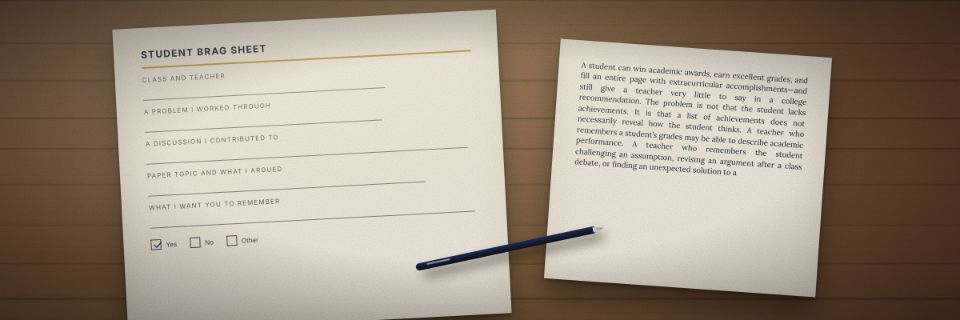
A concise counselor brag sheet can help accomplish that.
1. Understand What the Counselor’s Letter Adds
A counselor recommendation serves a different purpose from a teacher recommendation. A teacher can discuss a student's performance in a particular subject, while a counselor may be better positioned to explain the student's broader academic record, school context, personal circumstances, and contributions to the school community.
The College Board advises counselors to use recommendations to communicate qualities that grades and test scores alone cannot reveal. Its guidance encourages specific anecdotes and a broader picture of the student's academic, extracurricular, and personal development. It also recognizes that counselors working in large schools may need to solicit information from students, teachers, and families to write informed letters.
That guidance matters for students at large public schools. A counselor may be able to interpret a transcript and describe the school's academic environment but still need additional information about an individual student's work outside the counselor's direct observation.
A brag sheet can fill some of that information gap.
It should help the counselor answer questions such as:
What is distinctive about this student's academic development?
Has the student pursued an interest beyond the minimum requirements of a class?
What responsibilities or circumstances help explain the student's record? How has the student contributed to classmates, school organizations, or the wider community?
What would help an admissions reader understand the student in the context of this particular school?
The goal is not to manufacture an exceptional story. It is to make relevant facts visible.
2. Build a One-Page Summary Around Context, Milestones, and Contribution
A long résumé can document achievements without explaining their significance. A useful counselor summary should prioritize information that adds context or helps the counselor understand the student as an individual.
Use three main categories.
Academic Development
Identify the subjects, questions, and experiences that have shaped the student's intellectual direction.
Weak entry: “Interested in computer science and biology.”
More useful entry: “After taking biology and computer science, I began exploring how computational methods can help researchers analyze biological data. My independent project involved testing a simple classification approach and documenting where it produced unreliable results.”
The second entry gives the counselor a concrete example of the student's interest. The student should accurately describe the project's scope, methods, and personal contribution; a small project should not be presented as professional-level research.
Personal Context
Include circumstances that materially help explain the student's record or development, such as a significant family responsibility, a school transfer, limited access to advanced courses, or a disruption that affected a particular semester.
Weak entry: “I overcame many challenges.”
More useful entry: “During the first semester of junior year, I took on additional family responsibilities that reduced the time available for schoolwork. My grades in two courses declined during that period, and my performance improved after the schedule changed in the spring.”
Students should share only what they are comfortable disclosing and what is relevant. A counselor does not need intimate details simply to make a letter more personal.
Contribution to the School Community
Describe actions, not just titles.
Weak entry: “Debate club president; community service volunteer.”
More useful entry: “As debate club president, I organized weekly practice sessions for newer members and developed a system for pairing them with experienced debaters. Several members who had initially struggled with case construction began leading practice rounds themselves.”
The stronger entry explains what the student did and how it affected others. If the outcome cannot be verified, describe the activity without claiming a specific impact.
3. Give the Counselor Evidence They Can Actually Use
The most useful brag sheets include details that a counselor can incorporate into an accurate recommendation without having to reconstruct the student's entire high school experience.
For each major accomplishment or experience, provide four pieces of information:
What happened: Identify the class, project, responsibility, or activity.
What you contributed: Clarify your personal role rather than describing only the team's achievement. Why it matters: Explain what the experience reveals about your interests, growth, or contribution. Who can verify it: Identify a teacher, advisor, or other person who observed the work, when appropriate.
For example:
Experience: Independent environmental science project.
Contribution: Collected local observations, organized the data, and compared the results with published information.
Significance: Discovered that the initial hypothesis did not fully explain the pattern and revised the analysis. Possible source of context: Science teacher who reviewed the project.
This format helps the counselor identify a meaningful example and determine whether they can discuss it directly or need additional context from a teacher.
The Common App provides a dedicated counselor brag sheet, which asks students about academic strengths, possible majors and careers, college preferences, and other information useful to the counseling process. Families do not need to invent a complicated new system when an existing school or Common App questionnaire already covers the essentials.
4. Do Not Confuse a Counselor Brag Sheet with a Script
There is an important difference between helping a counselor remember relevant facts and telling the counselor what to write.
A student can appropriately share an experience, explain its significance, and identify a detail they hope the counselor will consider. The counselor must still decide what is relevant, what can be substantiated, and how to describe the student in their own professional judgment.
Avoid handing over paragraphs designed to be copied directly into the recommendation. A prewritten anecdote may include interpretations the counselor did not personally observe or would not independently endorse.
Instead of writing:
“Please describe me as an intellectually fearless researcher whose exceptional initiative distinguishes me from my peers.”
Provide the underlying facts:
“During my independent project, I tested two approaches, documented the limitations of the first, and revised my analysis. My science teacher reviewed the work, and I have included the project summary in case it is useful.”
The second version offers information without prescribing the counselor's conclusion.
The College Board's guidance encourages counselors to use specific examples and gather information from students and other people who know them. It does not suggest that the student should dictate the letter. The distinction protects the credibility of the recommendation while making the counselor's work easier.
5. Make Sure the Counselor Understands the School Context
One of the most valuable parts of a counselor recommendation is information that an admissions reader cannot infer from the transcript alone.
For example, a student may attend a school that offers few advanced courses in a particular subject. Another may have taken the most demanding available curriculum while balancing work or family responsibilities. A third may have transferred schools and had limited time to participate in established extracurricular activities.
The counselor may be able to explain these circumstances through the school's profile, the student's academic record, and firsthand knowledge.
Students can help by identifying relevant facts:
Were advanced courses unavailable or limited at the school?
Did the student pursue a subject independently because the school did not offer it?
Did a school transfer affect course sequencing or extracurricular participation?
Did a significant responsibility affect the student's available time? Is there a notable academic change that needs brief, factual context?
Do not assume that the counselor must explain every difficulty or that contextual information guarantees a more favorable admissions decision. The objective is an accurate understanding of the student's opportunities, choices, and development.
A counselor's explanation of the school environment can also benefit students whose records appear less unusual when viewed without context. It helps readers understand what the student did with the opportunities actually available.
6. Give the Counselor Time and a Clear Process
A well-prepared summary is most useful when delivered according to the school's procedures and with enough time for the counselor to review it.
Start early. Ask the counseling office when students should submit their questionnaire, résumé, and other supporting materials. Some schools establish specific deadlines or use their own forms.
Follow the requested format. If the school uses a counselor questionnaire or online portal, complete that process rather than sending multiple documents that duplicate the same information.
Prioritize. A concise one-page summary can highlight the most important information, with a résumé or project list available separately if requested.
Provide updates when they matter. A major award, significant academic development, or meaningful change in circumstances may warrant a brief update. Routine additions to an activity list may not.
Respect the counselor's role. Ask whether any additional information would be helpful. Avoid assuming that the counselor can meet repeatedly or tailor the same recommendation to every college.
The Common App's recommender guide explains how counselors use the application system to submit school forms and recommendations. Families should also check each school's internal procedures, since the Common App process does not replace local requirements.
7. A Counselor Brag Sheet Template
Students can adapt this compact template to their school's questionnaire.
Academic Direction: Which Subjects or Questions Have Most Influenced My Interests?
Academic milestone: What assignment, project, or experience best demonstrates my initiative or development?
School Contribution: What Have I Done to Improve a Class, Club, Team, or Community?
Personal context: Is there relevant information that helps explain my academic record or responsibilities?
Growth: What Changed in My Approach, Performance, or Interests During High School?
School Context: Were There Limits on Course Availability or Other Opportunities That Help Explain My Choices?
Additional evidence: Is there a teacher, advisor, or project summary that could help the counselor understand a particular experience?
Top three details: If the counselor remembers only three things about me, which facts would provide the most useful context?
The last question is especially valuable. It forces students to distinguish what is most meaningful from what is merely impressive on paper.
How Scholar Coach Helps Students Prepare for Counselor Recommendations
Scholar Coach helps students organize their experiences into a concise, accurate summary that complements the counselor's independent evaluation.
1. Identify the most informative details. We help students prioritize academic development, meaningful responsibilities, and contributions rather than submitting a long list of awards.
2. Clarify the evidence. We distinguish what the student actually did from the broader impact they believe it had, helping prevent inflated or difficult-to-verify claims.
3. Organize the personal context. We help students explain relevant circumstances clearly and proportionately, without disclosing unnecessary private information.
4. Prepare a counselor-friendly summary. We organize the most important facts into a concise document that can supplement the school's own questionnaire and résumé requirements.
5. Coordinate without scripting. We help students understand which details belong in their own essays, which may be useful to the counselor, and which should be supported by a teacher or advisor with firsthand knowledge.
A large public school's counselor may have limited time to learn every student's story. A concise, thoughtful brag sheet cannot eliminate that structural constraint, guarantee a personalized letter, or equalize every difference between schools. It can, however, make it easier for the counselor to recognize relevant information and represent the student accurately.
The objective is not to make the counselor's letter sound extraordinary at any cost. It is to ensure that the letter has the information needed to describe the student as more than a transcript, a GPA, or a list of activities.