A student earns a 98 in physics, scores perfectly on every calculus test, and completes every chemistry lab correctly. Their teacher writes that they are “an outstanding student with excellent analytical skills.”
The praise is positive. The problem is that it tells a college very little about how the student actually thinks.
Grades and test scores already document academic performance. A recommendation letter has a different opportunity: it can reveal what happens when a problem has no obvious solution, an experiment produces unexpected results, or a technical team must reconcile competing ideas.
MIT Admissions explicitly advises teachers to go beyond grades and academic performance, recommending specific stories that show intellectual risk-taking and characteristics that cannot be inferred from the rest of the application. Yale similarly emphasizes intellectual curiosity, resilience, and detailed discussion over generic superlatives. MIT's recommendation guide and Yale's recommendation guidance make the central principle clear: the strongest letters add meaningful information about the student.
For students applying to engineering, computer science, mathematics, physics, chemistry, biology, or other STEM fields, the goal is not to replace evidence of technical ability with vague praise about perseverance. It is to show how the student uses technical ability when the answer is not already known.
1. The Difference Between Knowing the Answer and Finding It
Consider two descriptions of a student in an advanced mathematics class.
Version A: “Jordan earned the highest grade in the class and demonstrated exceptional mathematical ability.”
Version B: “When the class encountered a difficult proof, Jordan tested several approaches before identifying an assumption that made the original argument fail. Rather than stopping at the correct answer, Jordan explained why the alternative proof worked and helped classmates understand the distinction.”
The first statement establishes achievement. The second illustrates a process: testing, evaluating assumptions, revising an argument, and communicating the reasoning.
Neither version is inherently false or useless. A high grade can establish a meaningful level of mastery, especially in a demanding course. But the second description provides evidence that a reader cannot obtain from a transcript alone.
This distinction applies across STEM disciplines:
Mathematics: Does the student recognize patterns, test conjectures, or find alternative proofs? Physics: Can the student connect mathematical models to physical phenomena and identify where assumptions break down?
Chemistry: Does the student interpret unexpected results and consider whether experimental conditions affected them?
Biology: Can the student distinguish observations from conclusions and recognize the limitations of evidence? Computer science: Does the student debug systematically, evaluate competing solutions, and consider edge cases?
Engineering: Can the student balance constraints, test prototypes, and revise a design when it fails? A recommendation should not force every student into the same problem-solving narrative. It should identify the particular intellectual habits the teacher has actually observed.
2. What Happens When the First Attempt Fails?
Failure can be valuable evidence in a recommendation—but only when the letter explains what the student did next.
Imagine a chemistry experiment that produces a result inconsistent with the expected outcome. One student immediately asks the teacher for the correct answer. Another checks the procedure, compares measurements, considers possible sources of error, and asks whether the evidence supports the original hypothesis.
The second student's response may reveal curiosity, methodological discipline, and comfort with uncertainty. But the important evidence is not that the experiment failed. It is the student's response to the failure.
A useful recommendation might explain:
What the student initially expected to happen.
What the actual result revealed.
Which possible explanations the student considered. How the student tested or revised those explanations.
What the student learned about the limits of the original approach.
The teacher does not need to describe a dramatic laboratory disaster. A small, well-observed moment can be more revealing than an elaborate account of a research project in which the student's personal contribution remains unclear.
The same principle applies to coding. A program that works on the first attempt may demonstrate competence. A debugging episode can reveal more about how the student reasons: Did they isolate the error, construct a test case, examine an assumption, and verify the fix?
The letter should not manufacture adversity or portray every mistake as a triumph. It should explain what the episode genuinely demonstrates.
3. Replace Abstract Praise with Technical Evidence
STEM teachers often have a precise vocabulary for achievement: accuracy, mastery, speed, correctness, and performance. Those qualities matter, but they can become repetitive when a recommendation relies on them exclusively.
The solution is not to eliminate adjectives. It is to connect them to observable behavior.
Generic Description
More Informative Evidence
“An excellent problem-solver”
Identified an unstated assumption and tested whether the conclusion still followed.
“Highly persistent”
Revised the approach after two unsuccessful attempts and explained why the third was more effective.
“A natural leader”
Organized competing ideas into a testable plan and invited teammates to challenge the assumptions.
“Exceptionally creative”
Proposed an alternative method that reduced a design constraint or explained an unexpected result.
“A brilliant programmer”
Traced a bug to an edge case, built a reproducible test, and verified that the correction did not introduce another error.
“Passionate about science”
Pursued a question beyond the assignment by consulting relevant evidence and bringing a more precise question back to class.
These examples are illustrative, not phrases students should insert into a brag sheet and ask teachers to copy. A teacher should use only the descriptions that match firsthand observations.
The Common App's recommender writing guide similarly encourages teachers to discuss approaches to specific assignments, intellectual engagement, responses to academic setbacks, and growth over time.
A letter becomes convincing when its conclusion follows from the evidence. Calling a student resilient is less informative than describing a moment that demonstrates resilience.
4. Show How the Student Contributes to Technical Collaboration
STEM achievement is not always an individual contest. Laboratory work, engineering projects, robotics teams, and collaborative programming assignments can reveal how a student reasons with other people.
A recommendation that says “Jordan works well with classmates” is pleasant but vague. A more useful account identifies the student's contribution to the group's thinking.
Perhaps the student noticed that two teammates were using different assumptions, clarified the disagreement, and suggested a test that could distinguish between their explanations. Perhaps a student who initially dominated a coding discussion learned to incorporate a teammate's more efficient algorithm. Or perhaps a student helped a struggling lab partner understand the relationship between the measurements and the underlying scientific model.
These episodes can reveal several distinct qualities:
Intellectual generosity: The student helps others understand rather than simply displaying personal expertise.
Openness to criticism: The student evaluates an opposing argument on its merits. Technical communication: The student can explain a complex idea clearly enough for others to use it.
Collaborative judgment: The student recognizes when to lead, listen, test, or revise. The Common App's teacher guidance explicitly includes classroom engagement, contributions to peers, and behavior during group projects as useful areas for teacher recommendations.
A collaborative example should still preserve the student's individual role. The goal is neither to claim sole credit for a team's achievement nor to let the team's impressive result substitute for evidence of the student's contribution.
5. Make Research Letters Specific About the Student’s Role
For students involved in laboratory research, independent engineering projects, or computer science research, the distinction between the project's achievement and the student's contribution becomes especially important.
A project may have produced a poster, prototype, publication, competition result, or promising preliminary finding. Those outcomes provide context, but they do not automatically establish the student's level of independence.
A research mentor can clarify what the student actually did:
Formulated or refined a research question. Selected a method under supervision.
Wrote code, collected data, or performed an experiment. Identified a limitation in the original approach.
Interpreted results or questioned an unsupported conclusion. Incorporated feedback and improved the work.
The mentor should also make the supervision context clear. A student who independently identified a methodological problem has demonstrated something different from a student who successfully carried out a prescribed procedure. Both contributions can be worthwhile; the letter should describe them accurately.
Yale specifically suggests that applicants engaged in advanced science or engineering research consider a research mentor's letter when it can add useful information. That does not mean every STEM applicant needs an additional recommendation. Yale also notes that most successful applicants submit only the required letters, and additional letters should offer a genuinely new perspective. See Yale's recommendation guidance.
For many students, a teacher who has observed their intellectual development over an entire academic year may provide stronger evidence than a prestigious research supervisor who knows them only briefly.
6. Help the Teacher Remember the Right Evidence
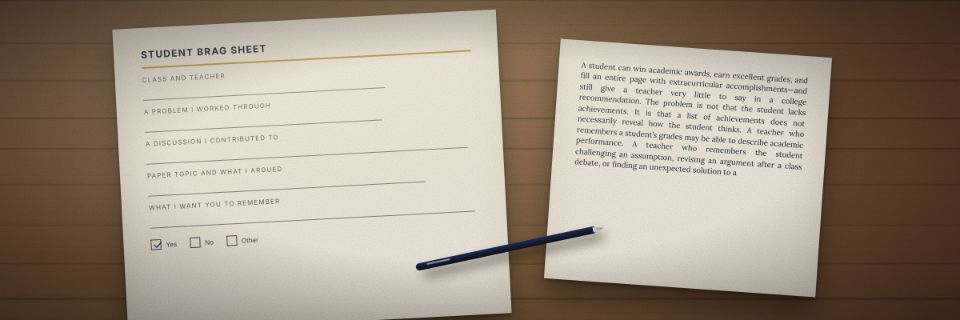
Students should not write their own recommendation letters or script the praise they want to receive. They can, however, make it easier for a teacher to recall meaningful examples.
A concise brag sheet or conversation can include:
A challenging problem: Which assignment, proof, experiment, or technical obstacle required the most thought? A turning point: Was there a moment when the student's initial explanation proved inadequate or a new approach changed the result?
A specific contribution: What did the student personally do, rather than what did the class or team accomplish? A response to feedback: What changed after the teacher challenged the student's reasoning or suggested a revision? A question pursued beyond class: Did the student investigate a topic, test an idea, or return with a more sophisticated question?
A collaborative moment: Did the student help a peer, reconsider an argument, or improve the group's approach?
These prompts are memory aids, not a checklist the teacher must complete. The teacher should select the examples that best reflect their own observations and the student's actual strengths.
MIT recommends asking teachers early and choosing people who know the applicant as more than a student who performs well on tests. Its guidance also emphasizes that recommendations should provide facts and anecdotes that add information beyond the application itself.
7. A Practical Checklist for a Strong STEM Recommendation
Before submitting a letter, a teacher can consider the following questions:
Does the letter describe at least one specific example of the student's reasoning or intellectual engagement?
Does it explain what made the problem, experiment, or question challenging? Does it distinguish the student's individual contribution from the group's achievement? Does it show how the student responded to uncertainty, feedback, or an unexpected result when such evidence is available?
Does It Describe Communication or Collaboration Where Relevant?
Does it provide context for exceptional performance rather than relying entirely on grades and rankings?
Does the Praise Sound Like the Teacher’s Genuine Assessment, Supported by Firsthand Knowledge?
Not every strong letter needs to answer every question. A mathematics teacher may have compelling evidence of proof-based reasoning but little basis for discussing laboratory work. A computer science teacher may be able to describe debugging and collaboration in detail. The strongest letter is specific to the relationship and the subject.
Most importantly, there is no universal admissions checklist proving that a letter containing certain keywords will outperform another. Phrases such as “resilience in problem-solving” are not magic words. The concrete example supporting the phrase is what makes it meaningful.
How Scholar Coach Helps Students Prepare for Strong STEM Recommendations
Scholar Coach helps students identify the academic experiences that a teacher can credibly discuss—not manufacture a story for the teacher to repeat.
1. Identify the evidence behind the achievement. We look beyond grades to specific proofs, experiments, coding challenges, design decisions, and research questions that reveal how the student thinks.
2. Reconstruct the problem-solving process. Students clarify what they tried, what did not work, what evidence changed their approach, and what they learned. This also strengthens their ability to discuss their academic work in interviews and essays.
3. Prepare a concise, factual brag sheet. We help organize relevant projects, individual contributions, feedback, and intellectual interests so the teacher can recall useful details without being handed a scripted letter.
4. Match the recommender to the evidence. We help students consider which teachers know their work well and can provide a distinct, firsthand perspective, while respecting each college's recommendation requirements.
5. Keep the letter authentic. The teacher remains responsible for the recommendation's content and judgment. Our role is to help students make their real intellectual work easier to recognize and describe.
The objective is not to make a student sound like a future Nobel laureate or an already accomplished engineer. It is to help the recommendation reveal something grades cannot: how the student approaches difficult questions, learns from evidence, and contributes to the work of understanding how the world operates.