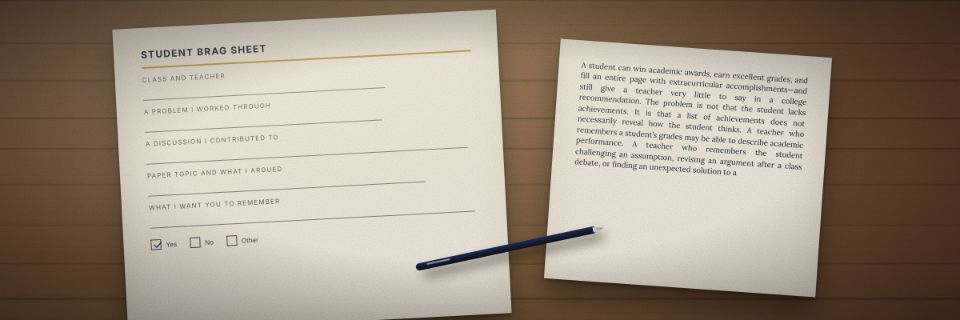
Your student has won three academic awards, earned a 4.0 GPA, and completed a dozen extracurricular activities. Their brag sheet lists every accomplishment in chronological order, complete with competition rankings, leadership titles, and hours volunteered.
Their teacher reads it, opens the recommendation form, and writes: “Alex is an outstanding student who consistently demonstrates academic excellence, leadership, and dedication.”
Nothing is wrong with the sentence. The problem is that it could describe hundreds of applicants.
A brag sheet is supposed to help a teacher write a more personal recommendation, not reproduce a résumé the admissions office can already review. The Common Application's recommender guidance describes brag sheets as a way for students to share interests, experiences, accomplishments, and personal qualities with recommenders. MIT Admissions goes further: effective recommendations use specific stories to reveal qualities that grades and other application materials cannot show. MIT's recommendation-writing guide illustrates the difference between generic praise and a detailed account of what a student actually did.
The best brag sheet answers a different question from a résumé: What specific moments would help my teacher remember how I think, learn, and contribute?
1. Stop Repeating What the Teacher Already Knows
Teachers can usually access grades, assignments, classroom performance, and—in many cases—school records documenting activities or honors. A brag sheet should not assume they remember every meaningful interaction, however. Its purpose is to connect the student's accomplishments to details that might otherwise be forgotten.
Compare these two responses to a typical brag-sheet prompt.
Weak Response
What Are Your Great Est Academic Accomplishments?
“I earned an A in AP Biology, received a science department award, and participated in the science fair.”
Stronger Response
What Is a Moment in This Class That Reflects How You Think?
“During our genetics unit, I questioned whether the simplified inheritance model we were using adequately explained a particular pattern. After class, I asked how the model would change if another factor influenced the outcome. That conversation led me to look more carefully at the assumptions behind the model.”
The second response gives the teacher a possible memory to revisit. If the teacher remembers the exchange and agrees with the description, it may provide the basis for a specific anecdote.
Notice what the stronger answer does not do: it does not claim that asking a question proves extraordinary scientific talent. It provides a concrete interaction that the recommender can assess in context.
The rule: List the accomplishment briefly when relevant, then explain the moment that reveals something about the student behind it.
2. The Six Questions That Make a Brag Sheet More Useful
Instead of completing every prompt with another award or activity, students can use the following framework to recall moments worth sharing. The examples are illustrative; students should substitute their own experiences and avoid inventing conversations or outcomes.
Question 1: What question did you ask that went beyond the assignment?
Weak answer: “I am very curious and always participate in class.”
Stronger answer: “During our unit on the American Revolution, I asked whether the same political argument could be considered liberating for one group while restricting the rights of another. I wanted to understand how the people affected by the revolution might interpret its promises differently.”
Why it helps: The response identifies a question, a classroom context, and the student's intellectual interest. A history teacher who remembers the discussion can decide whether it illustrates the student's ability to examine competing perspectives.
Students should not try to make ordinary questions sound profound. A genuine question about an unexpected result, a confusing passage, or an apparent contradiction can be more revealing than a question written to impress an admissions reader.
Question 2: When did you change your mind?
Weak answer: “I am open-minded and willing to learn from others.”
Stronger answer: “In our discussion of a novel, I initially argued that the protagonist's decision was entirely selfish. After a classmate pointed out a detail I had overlooked, I reread the scene and revised my interpretation. I still disagreed with part of my classmate's argument, but I could no longer defend my original explanation.”
Why it helps: This answer gives the teacher a concrete example of intellectual flexibility. It also avoids presenting the student as someone who is always correct.
A strong recommendation does not require a dramatic transformation. A small revision in reasoning can demonstrate how a student responds to evidence and disagreement.
Question 3: What did you do when your first approach failed?
Weak answer: “I never give up and always work hard.”
Stronger answer: “For our engineering project, my original design repeatedly failed the stability test. I changed one variable at a time rather than rebuilding the entire structure, which helped me identify where the design was weakest. I then revised the support system and tested it again.”
Why it helps: The answer identifies the obstacle, the student's response, and the reasoning behind the next attempt. An engineering teacher may remember the project and be able to comment on the student's persistence or technical judgment.
The same framework works in mathematics, writing, research, music, and other subjects. Describe the actual difficulty and what you did in response, not merely the fact that you overcame it.
Question 4: What piece of work best represents how you think?
Weak answer: “My final essay was one of my best assignments, and I received a 98.”
Stronger answer: “In my final essay on Macbeth, I argued that Macbeth's ambition alone did not explain his choices; the language of the play also showed how he gradually reinterpreted hesitation as weakness. I revised my thesis after realizing that my first draft described his behavior without fully explaining the shift in his reasoning.”
Why it helps: The teacher has a specific assignment, an argument, and a revision process to recall. The grade remains useful context, but it is no longer the entire story.
Students can use the same structure for a mathematical proof, laboratory report, research paper, programming project, or historical analysis.
Question 5: How did you contribute to someone else's learning?
Weak answer: “I am a natural leader and a great team player.”
Stronger answer: “During our group statistics project, two teammates disagreed about how to interpret the data. I suggested that we compare their explanations against the actual distribution before choosing a conclusion. That helped us separate the question of what the data showed from what we expected to find.”
Why it helps: The response gives the teacher a specific interaction that may demonstrate collaboration, communication, or judgment. It also identifies what the student contributed rather than claiming credit for the entire team's result.
If a student tutored a classmate, helped organize a team, or changed how a group approached a problem, the most useful detail is what they actually did and what followed.
Question 6: What would your teacher know about you that your transcript cannot show?
Weak answer: “I am hardworking, passionate, and dedicated to success.”
Stronger answer: “I often stayed after class to ask about the assumptions behind the models we were learning. One conversation about the limits of a simplified economic model led me to examine how changing one assumption could change the conclusion. I enjoyed that process even when it was not part of the test.”
Why it helps: This response points toward motivation and intellectual habits rather than repeating academic performance. If the teacher observed the behavior, they can decide whether and how to describe it in the letter.
Students should also feel free to share a meaningful experience that does not fit an academic narrative. The objective is to help the teacher understand the student more fully, not to turn every part of life into an admissions strategy.
3. The Exact Formula: Turn a Memory Into a Useful Answer
For students who struggle to answer open-ended prompts, this four-part structure is a practical starting point:
Context: What class, assignment, project, or conversation was involved?
Moment: What specific question, difficulty, disagreement, or decision occurred? Action: What did you say, test, revise, investigate, or contribute? Meaning: What did the experience reveal about your thinking, interests, or development?
Consider this example:
Prompt: Describe an academic moment you hope your teacher remembers.
Context: During a chemistry lab, our measured result differed from the expected value.
Moment: I initially assumed that our group had made a procedural mistake.
Action: After reviewing our measurements, I questioned whether the assumption behind our calculation fully accounted for the conditions of the experiment. I discussed the possibility with my teacher and revised my explanation to distinguish what we had observed from what we could actually conclude.
Meaning: The experience made me more attentive to the difference between obtaining a result and understanding what that result supports.
This answer does not need to become the teacher's paragraph word for word. It gives the teacher a specific event to consider and leaves the teacher free to interpret it independently.
4. How to Fill Out the Brag Sheet Without Sounding Manufactured
A brag sheet can become less useful when every response sounds optimized for admissions. Students should avoid exaggerated descriptions, artificial intellectual language, and claims about how a teacher must have perceived them.
Use these practical rules:
Choose two or three strong memories per teacher. A handful of relevant examples is generally more useful than a long catalogue of every accomplishment.
Be specific about the subject. “During our unit on probability” gives the teacher a clearer reminder than “in math class.”
Use your own words. If you would never describe an idea as “epistemologically transformative,” do not insert that phrase to sound sophisticated.
Include an outcome only when you know it. Do not claim that a question changed the entire class discussion if you cannot support that description.
Separate facts from interpretation. State what happened first; explain what it meant to you afterward.
Respect the teacher's perspective. A recommender may remember the event differently or choose another example. The student supplies context, not instructions for what the teacher must say.
The Common Application's teacher and counselor writing guide identifies classroom engagement, approaches to assignments, intellectual interests, and contributions to peers as potentially useful material for recommendations. Those are good areas to reflect on because they connect the student's self-description to experiences a teacher may have observed.
5. A Brag Sheet Template Students Can Complete
Use the following prompts as a compact worksheet. A few thoughtful sentences per answer are enough to get started.
A question I asked:
What question did I ask in class or after class that reflected a genuine interest or confusion?
A moment of intellectual growth:
When did I change my mind, revise an argument, or recognize a flaw in my original reasoning? A difficult problem:
What did I do when an assignment, experiment, proof, or project did not work as expected? A piece of work I value:
Which assignment best represents how I think, and what was distinctive about my approach? A contribution to others:
When did I help a classmate, improve a group project, or contribute an idea that moved the work forward? An interest beyond the curriculum:
What topic did I investigate further, and what specifically made me want to know more? A detail my teacher may not know:
Is there relevant context about my interests, responsibilities, development, or circumstances that would help the teacher understand me more accurately?
The two or three moments I hope my teacher remembers:
Which examples are most relevant to this teacher's class and most likely to be recognizable from their own experience?
Students should complete this worksheet honestly and selectively. They do not need a spectacular anecdote for every prompt. A teacher who can discuss one meaningful moment in depth may have more to say than a teacher presented with ten disconnected achievements.
How Scholar Coach Helps Students Prepare Better Brag Sheets
Scholar Coach helps students organize real academic experiences into clear, specific reminders that teachers can use independently when writing recommendations.
1. Identify the strongest memories. We help students look beyond awards and grades to discussions, assignments, revisions, questions, and challenges that reveal how they think.
2. Turn vague claims into concrete examples. “I am curious” becomes a description of a question the student actually asked. “I am resilient” becomes an account of how the student responded when an approach failed.
3. Build a teacher-specific brag sheet. A mathematics teacher may have seen the student's reasoning during proofs, while an English teacher may know their interpretive voice and revision process. Each teacher should receive relevant reminders rather than an identical packet.
4. Keep the document concise and credible. We help students prioritize a few useful examples, clarify their individual contributions, and remove inflated language or unsupported claims.
5. Preserve the recommender's independence. The student supplies factual context and memories. The teacher decides what to include, how to describe the student, and what recommendation to make.
The purpose of a brag sheet is not to make a teacher write a predetermined letter. It is to help them remember what made the student distinctive in their own experience.
An award tells the reader what a student achieved. A well-chosen memory can help explain how the student thinks, what motivates them, and how they respond when an answer is not obvious. The best brag sheets give teachers the raw material for that richer picture—without trying to write the picture for them.