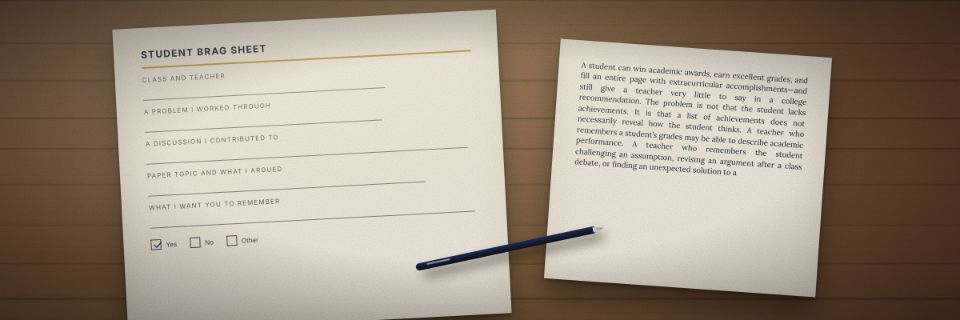
A student earns an A in English, writes polished essays, and participates regularly in class discussions. Those are encouraging signs, but they do not necessarily reveal how the student thinks as a historian, literary critic, or philosopher.
Can the student distinguish a source's argument from its assumptions? Can they reconcile conflicting historical accounts without ignoring inconvenient evidence? Can they interpret a passage closely enough to defend a reading that is not immediately obvious? When a teacher challenges a thesis, can the student revise the argument rather than merely improve its wording?
These are the kinds of questions that a thoughtful humanities recommendation can help illuminate.
There is no universal admissions rubric requiring every humanities applicant to demonstrate a fixed set of advanced writing techniques. Colleges also differ in how they review applications and whether students apply directly to a particular major. But official admissions guidance from Yale and MIT emphasizes the value of specific examples that reveal intellectual curiosity, academic development, and qualities that grades alone cannot show.
For humanities students, the strongest recommendation is therefore not simply one that calls a student an excellent writer. It explains what the student does with ideas, evidence, language, and criticism—and illustrates those qualities through work the teacher has actually observed.
Sources: Yale Admissions: Recommendation Letters; MIT Admissions: How to Write Good Letters of Recommendation.
1. Move Beyond “Excellent Writer” to Specific Intellectual Skills
“Excellent writer” is a positive description, but it can mean many different things. One student may write with stylistic flair; another may construct exceptionally clear arguments. A third may be skilled at interpreting difficult texts, while a fourth excels at organizing evidence from multiple sources.
A useful humanities recommendation identifies what distinguishes the student's work and provides evidence.
For example, a history teacher might explain that a student compared two contemporary accounts of the same event, identified differences in their descriptions, and considered how each author's position influenced the narrative. An English teacher might describe how a student supported an interpretation of a novel through close analysis of diction, imagery, or narrative perspective. A philosophy teacher might discuss how a student identified an unstated premise in an argument and tested whether the conclusion followed.
Each example reveals a different intellectual strength.
The Common App's teacher guidance specifically encourages recommenders to discuss students' approaches to assignments, topics in which they excel or show particular interest, engagement in classroom discussions, and willingness to learn beyond what is expected.
For a humanities applicant, this means the recommendation should go beyond confirming that the student submits assignments on time and earns high grades. It should help the reader understand how the student approaches the discipline.
A useful checklist for a teacher includes:
Interpretation: Does the student notice significant details, assumptions, patterns, or ambiguities? Evidence: Can the student support a claim with relevant textual or historical evidence?
Argument: Can the student develop a clear thesis and explain why the evidence supports it?
Intellectual flexibility: Can the student consider competing explanations or revise an interpretation?
Expression: Can the student communicate complex ideas with clarity and precision? These are useful dimensions for describing humanities work, not a mandatory checklist that every admissions officer applies in the same way.
Source: Common App: Writing Guide for Counselors and Teachers.
2. History: Show How the Student Handles Conflicting Evidence
Historical thinking requires more than remembering events, dates, and interpretations presented in class. Students must learn to evaluate sources, understand context, distinguish evidence from inference, and recognize that accounts of the past may differ.
A strong history recommendation can make these abilities visible through a particular research paper, document-based essay, or classroom investigation.
Imagine a student writing about the causes of a political revolution. Rather than simply summarizing a textbook account, the student compares speeches, correspondence, and later historical interpretations. One source emphasizes economic grievances; another stresses political exclusion. The student considers the perspective and limitations of each source before developing a thesis that accounts for the competing explanations.
A teacher who supervised that process could describe several valuable observations:
The student selected evidence that complicated, rather than merely confirmed, the initial argument.
The student distinguished what a primary source directly established from what could only be inferred.
The student revised a thesis when additional evidence weakened the original explanation.
The final paper synthesized multiple sources into an argument rather than presenting a sequence of summaries.
These details show how the student reasons historically. They are more informative than a general statement that the student possesses exceptional analytical skills.
The teacher should not need to claim that a high school paper constitutes professional historical scholarship. The meaningful comparison is with the work expected in the student's academic setting: did the student approach the assignment with unusual care, independence, or intellectual maturity?
Families can help teachers recall relevant work by providing the title of a major paper, the research question, and a brief explanation of why the student found it meaningful. The teacher should independently decide which details best represent the student's work.
3. Literature: Demonstrate Close Reading, Not Just Appreciation
Students who enjoy literature often describe themselves as passionate readers. That interest matters, but a recommendation becomes more informative when it shows what the student does while reading.
Close reading involves examining how a text produces meaning through choices such as diction, syntax, imagery, structure, point of view, and genre. Students may also investigate how historical context shapes a work or how different interpretations emerge from the same passage.
Consider a student analyzing a novel's narrator. Instead of accepting the narrator's account as straightforward fact, the student notices inconsistencies between what the narrator claims and what the surrounding details suggest. The student develops an interpretation of how the narrative structure shapes the reader's understanding and supports that interpretation with textual evidence.
A teacher could describe the student's ability to:
Identify a meaningful detail that other students initially overlooked.
Develop an interpretation that goes beyond plot summary. Use quotations to support an argument rather than decorate it. Consider an alternative reading and explain why the evidence supports one interpretation more strongly.
Revise an argument when close examination of the text reveals a weakness.
A recommendation need not use technical literary terminology to communicate these strengths. In fact, a clear description of what the student noticed and how they supported their reading may be more revealing than a string of specialized terms.
The goal is not to make the student sound like a graduate student. It is to show a reader how the student engages with literary complexity.
4. Philosophy: Explain the Student’s Reasoning, Not Just Their Opinion S
In philosophy, a student can express an interesting opinion without having developed a strong philosophical argument. The distinction lies in how the student examines the reasons supporting a claim.
A teacher might describe a student who initially argues that a particular action is morally wrong. During discussion, another student introduces a counterexample. Rather than dismissing it, the applicant examines which assumption the original argument depends on, revises the claim, and explains why the revised position better accounts for the competing case.
That process can reveal several important habits:
Identifying premises and conclusions. Recognizing hidden assumptions.
Constructing counterexamples.
Distinguishing a persuasive assertion from a supported argument.
Responding to objections without abandoning logical consistency.
A recommendation can also describe a student's intellectual humility: the willingness to acknowledge when an argument fails and the discipline to rebuild it.
These observations are more useful than describing a student as “deep,” “profound,” or “wise” without explanation. A teacher who can identify the question that challenged the student, the reasoning that followed, and the student's response to criticism gives the admissions reader a concrete picture of the student's thinking.
Not every student interested in philosophy needs to demonstrate formal logic or write about a particular philosophical tradition. The relevant evidence depends on the course, assignment, and level of instruction.
5. The Revision Process: Evidence of How a Student Develops Ideas
A final paper can demonstrate the quality of a student's writing, but the process that produced it may reveal something equally important.
Revision is not merely correcting grammar, replacing repetitive words, or making sentences sound more sophisticated. Substantive revision can involve narrowing a research question, reorganizing evidence, reconsidering an assumption, changing the thesis, or removing a claim that the available evidence cannot support.
Suppose a student begins with a broad argument about the causes of a historical conflict. The teacher's feedback reveals that the paper treats several distinct causes as interchangeable. The student returns to the sources, reorganizes the analysis, and develops a more precise explanation of how those factors interacted.
A teacher who observed this process could describe the student's response to feedback, independence, and willingness to reconsider an initial position.
Similarly, an English teacher might explain how a student's first interpretation of a poem relied on a general impression, while the revised paper examined specific word choices and structural patterns. A philosophy teacher might discuss how a student responded to an objection by identifying a weakness in the original premise.
These examples are especially useful because they show development rather than presenting ability as a fixed trait.
However, recommendations should not manufacture a dramatic growth narrative. A teacher should describe the actual revision process and its significance. A student who wrote an excellent first draft may demonstrate intellectual maturity in a different way, such as recognizing a subtle counterargument or extending an analysis independently.
The point is to identify the work the student actually did and explain what it reveals.
6. A Checklist for Students and Teachers Preparing Humanities Recommendations
Students should not script their teachers' letters. They can, however, help teachers recall relevant work by organizing accurate information about their academic experiences.
The following checklist can guide that preparation.
For the student:
Identify one or two substantial humanities assignments that genuinely challenged you. Summarize the central question, the sources or texts you examined, and the argument you developed. Recall a meaningful moment in the process: a counterargument, an unexpected discovery, a difficult revision, or feedback that changed your approach. Explain what you learned without claiming that the work was more sophisticated than it was.
Provide this context to the teacher in the format and timeframe requested.
For the teacher, if useful:
Describe the assignment and the context in which you observed the student's work.
Identify a specific strength in the student's reading, research, argumentation, or writing.
Support that assessment with an accurate example from the student's work or classroom participation. Explain how the student responded to feedback, ambiguity, or a competing interpretation, if relevant. Add an independent perspective on the student's intellectual character, development, or contribution to the classroom.
Not every recommendation needs to cover every skill. A concise letter built around one or two well-chosen observations can provide more insight than a long list of generic compliments.
Yale's admissions guidance reinforces this principle: recommenders are most helpful when they know the student well and can discuss the substance of the student's intellect and character. The recommendation's purpose is to add a credible perspective, not to reproduce the student's application essays in a different voice.
Source: Yale Admissions: Recommendation Letters.
How Scholar Coach Helps Humanities Students Present Their Academic Depth
Scholar Coach helps students and families prepare for the recommendation process by identifying meaningful academic evidence while preserving the teacher's independent judgment.
Identify representative work. We help students review major papers, research projects, seminar discussions, and revisions to identify experiences that genuinely demonstrate their engagement with the humanities.
Clarify the intellectual contribution. We help students articulate the question they investigated, the evidence they considered, and the reasoning that shaped their conclusions—without exaggerating the sophistication of the work.
Prepare factual background materials. We organize relevant assignment details, accomplishments, and reflections into concise summaries teachers can use as memory aids if they choose.
Coordinate the broader application. We help families consider how recommendations complement transcripts, essays, and activity descriptions, reducing unnecessary repetition while allowing different parts of the application to provide distinct perspectives.
Preserve authenticity and accuracy. We avoid scripting teachers' evaluations or asking them to make claims they cannot support. The recommender remains responsible for deciding what to emphasize and how to describe the student's work.
A humanities recommendation is strongest when it makes a student's thinking visible. The teacher does not need to declare the student a future historian, novelist, or philosopher. A specific account of how the student interpreted a difficult passage, weighed conflicting sources, constructed an argument, or reconsidered an assumption can provide a more credible picture of readiness for further study.