A student spends three hours helping a friend understand a calculus problem. They try one explanation, realize it is not working, draw a different diagram, and ask their friend to explain the solution back in their own words. By midnight, both students understand the concept better.
The next morning, the student submits a college application listing a mathematics award, a leadership position, and a high grade in calculus.
Which Version Tells an Admissions Reader More About How That Student Might Contribute to a College Community?
The award establishes achievement. The study session reveals behavior: how the student responds when another person struggles, whether they can explain an idea clearly, and whether they treat learning as a competition or a shared pursuit.
That distinction matters when a college accepts or encourages a peer recommendation. Dartmouth, for example, strongly encourages applicants to submit a peer recommendation that offers a perspective distinct from the views of teachers and counselors. Its official guidance asks recommenders to comment on the applicant's character, abilities, and potential contributions to a college community. Dartmouth's peer recommendation guidance explains who can write one and why the perspective matters.
A peer letter is not a popularity contest, a friendship tribute, or another résumé. At its best, it shows what it is like to think, work, and learn alongside the applicant.
1. What Can a Classmate Reveal That a Teacher Cannot?
A teacher may observe a student's performance in class, the quality of their assignments, and their contributions to academic discussions. A classmate may see a different side of the same student: how they behave during an informal study session, respond when a group gets stuck, or handle disagreement when there is no grade attached to the conversation.
Neither perspective is automatically more valuable. Each can contribute different information.
Yale's official recommendation guidance emphasizes that letters can reveal how students think and learn, contribute to their school communities, and affect classroom dynamics. Yale also cautions that specific, thoughtful discussions are more useful than strings of generic superlatives. Yale's recommendation guidance focuses primarily on teacher recommendations, but the underlying principle is relevant to peer letters: firsthand examples provide a richer picture than unsupported praise.
A peer can offer evidence of qualities such as:
Intellectual generosity: Sharing an explanation or resource without treating knowledge as a personal advantage.
Humility: Acknowledging a mistake or changing an argument when someone presents better evidence.
Collaborative problem-solving: Helping a group identify why an approach is failing rather than blaming a teammate.
Curiosity: Continuing a discussion after the assignment ends because the question remains interesting.
Respectful disagreement: Challenging an idea without belittling the person who expressed it.
These qualities are not magic admissions keywords. A letter becomes informative when the recommender describes a genuine interaction that illustrates them.
2. Choose the Person Who Has Seen You Think
Students often assume their closest friend is automatically their best peer recommender. Closeness can help, but the most useful choice is someone who knows the applicant well enough to describe them specifically and honestly.
Dartmouth explicitly allows a peer recommendation from a friend, classmate, teammate, sibling, cousin, coworker, or another person the applicant considers a peer. It advises applicants to choose someone who can provide fresh insight into their interests and character—not another person in a supervisory role.
Consider three possible recommenders:
The longtime best friend: Knows the applicant extremely well but has little experience working with them on academic or intellectual projects.
The debate partner: Has watched the applicant research arguments, challenge assumptions, lose rounds, reconsider positions, and help prepare teammates.
The robotics teammate: Has worked with the applicant through failed designs, disagreements about technical decisions, and the pressure of a competition deadline.
The best choice depends on the person and the story they can credibly tell. The debate or robotics partner may be able to offer unusually concrete examples of the applicant's intellectual character. But a close friend who has witnessed meaningful curiosity, generosity, or personal growth could write an equally insightful letter.
The right question is not, “Who likes me most?” It is: Who can describe something meaningful about how I think or treat other people that the rest of my application does not already show?
3. The Difference Between a Friendship Tribute and an Intellectual Por Trait
A weak peer letter often relies on statements that could describe almost any good friend.
Generic version:
“Sam is one of the smartest people I know. Sam is kind, hardworking, funny, and always willing to help. We have been friends for years, and I know Sam will succeed in college.”
This may be sincere, but it leaves the reader with little evidence. What does Sam do that makes the recommender regard them as smart? What kind of help do they offer? What happens when someone disagrees with them?
Now consider a more specific example.
Stronger version:
“During our biology study sessions, I kept confusing correlation with causation. Sam did not simply give me the definition again. Sam drew two possible explanations for the same data and asked me what additional evidence would distinguish them. When I chose the wrong explanation, Sam helped me trace the assumption behind my answer instead of just telling me it was incorrect. I began using that approach on other problems, even when Sam was not there.”
The second account gives the reader an observable interaction, the applicant's behavior, and a concrete effect on another person. It does not need to declare Sam a genius; it lets the example do the work.
The strongest peer letters often reveal two things at once: how the applicant thinks and how their thinking affects the people around them.
4. Five Questions to Help a Peer Remember the Right Moments
A peer recommender should write in their own voice. Applicants can make the process easier by asking the recommender to reflect on a few genuine experiences— without supplying a script or dictating the conclusion.
Question 1: When Did We Work Through a Difficult Problem Together?
Possible example: “During our statistics project, we disagreed about which model best represented the data. Instead of insisting on my first choice, you suggested that we test both approaches against the same observations.”
What it can reveal: How the applicant handles uncertainty, evaluates evidence, and works through disagreement.
Question 2: When Did the Applicant Help Someone Understand an Idea?
Possible example: “I was struggling with a programming assignment, and you helped me isolate the bug by testing one assumption at a time. You asked me to explain why each change should work rather than simply sending me your code.”
What it can reveal: Patience, communication, and a willingness to help another person develop independent understanding.
Question 3: When Did the Applicant Change Their Mind?
Possible example: “During a debate about a historical event, you initially defended one interpretation. After we examined a source that complicated the argument, you revised your position and explained what the new evidence changed.”
What it can reveal: Intellectual humility and the ability to treat disagreement as an opportunity to learn.
Question 4: When Did the Applicant Make a Group Better?
Possible example: “Our science team had several competing ideas for the experiment. You organized the options around what we could actually test with the time and equipment available, which helped us settle on a workable plan.”
What it can reveal: Collaboration, practical judgment, and the ability to turn discussion into action.
Question 5: What Does the Applicant Do When Nobody Is Grading the Work?
Possible example: “After our literature assignment ended, you kept asking why the narrator's account contradicted details elsewhere in the novel. Our conversation led us to compare passages we had not needed for the original assignment.”
What it can reveal: Curiosity that extends beyond formal requirements.
Not every student will have an example for every question. A recommender should choose the experiences they genuinely remember and consider most revealing. A small, authentic moment is more useful than an elaborate story constructed to make an applicant sound exceptional.
5. Why Shared Struggles Can Be More Revealing Than Shared Success Es
A peer recommendation does not need a dramatic breakthrough or an all-night study session. What matters is the behavior the recommender observed.
A successful group project can show technical competence, but the process may reveal more about how the applicant works with others. Did they listen when someone proposed a different approach? Did they acknowledge another student's contribution? Did they help resolve a disagreement about the evidence? Did they recognize when their own idea was not working?
For example, a robotics teammate might describe a design that repeatedly failed a stability test. Instead of blaming the person who built it, the applicant suggested isolating the variables and testing one change at a time. The team discovered that its original assumption was wrong and revised the design.
The important detail is not simply that the team succeeded. It is how the applicant behaved when success was uncertain.
Similarly, a debate partner might explain how the applicant helped prepare an opposing argument to test the weaknesses in their own case. A lab partner might describe how the applicant distinguished an unexpected result from an incorrect measurement. A friend might recall a conversation in which the applicant genuinely reconsidered an opinion after hearing a different perspective.
These stories should not be exaggerated into claims of exceptional leadership every time someone helps a teammate. Their value lies in the specific behavior they reveal.
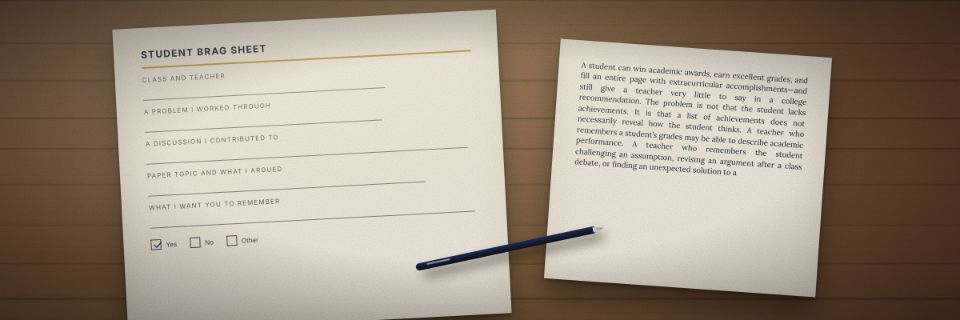
6. A Practical Peer Recommendation Worksheet
Applicants can use this framework to identify a suitable recommender and help that person recall useful examples.
Our Relationship: How Do We Know Each Other, and How Long Have We Known Each Other?
A shared intellectual experience: What class, project, discussion, competition, or independent interest have we explored together?
A moment of problem-solving: When did we encounter a difficult question or disagreement, and what did the applicant do?
A Moment of Humility or Growth: When Did the Applicant Revise an Idea, Accept Criticism, or Acknowledge a Mistake?
A contribution to me or the group: How did the applicant help someone understand an idea, improve a plan, or make a group discussion more productive?
A distinctive quality: What have I personally observed that would be difficult to infer from the applicant's transcript, activity list, or own essays?
A concrete example: Which one or two experiences can I describe accurately, in my own words, with enough detail for the reader to understand what happened?
The applicant should not fill in the recommender's answers or require the peer to use a particular story. The worksheet is a way to prompt reflection, not to direct the letter's conclusion.
7. Important: Check Whether the College Wants a Peer Recommendation
A peer letter is not a universal requirement, and applicants should not assume that every selective college wants one.
Dartmouth strongly encourages a peer recommendation. Other institutions may not accept one, may not request one, or may prioritize their required teacher and counselor evaluations. For example, MIT requires two teacher recommendations and says that most applicants and admitted students do not submit supplemental recommendations. MIT's recommendation requirements illustrate why applicants should check each college's current policy before asking someone to write an additional letter.
Before choosing a recommender:
Read the college's current recommendation instructions. Confirm that a peer letter is permitted and whether it is optional or encouraged. Choose a peer who can add a genuinely different perspective.
Give the recommender enough time to write thoughtfully.
Let the recommender submit the letter independently and in their own voice. More letters do not automatically make an application stronger. A peer recommendation is most useful when it adds information that the required materials do not already convey.
How Scholar Coach Helps Students Prepare for Peer Recommendations
Scholar Coach helps students identify the experiences that reveal how they think and collaborate, then organize those experiences without turning a personal recommendation into a scripted exercise.
1. Identify the right recommender. We help students evaluate who has firsthand knowledge of their intellectual habits, teamwork, and character—not simply who is closest to them.
2. Find the moments worth remembering. We look for genuine examples from study sessions, research projects, debate preparation, group assignments, and conversations that reveal how the student approaches problems.
3. Separate evidence from praise. Instead of relying on labels such as “brilliant,” “kind,” or “a natural leader,” we help students identify the specific behavior that supports a meaningful description.
4. Prepare a concise reflection guide. Students can share relevant context and reminders while allowing the peer to decide which experiences matter and how to describe them.
5. Check the college's requirements. We help students distinguish schools that encourage peer recommendations from those that do not request or accept them, so they can focus on the materials each institution actually wants.
A peer recommendation should not prove that everyone likes the applicant. It should offer a credible view of what the applicant contributes when learning becomes a shared activity.
The most memorable letter may describe a difficult proof, a failed experiment, a debate that changed someone's mind, or an ordinary study session in which one student helped another see a problem differently. The achievement matters, but the interaction reveals the person behind it.