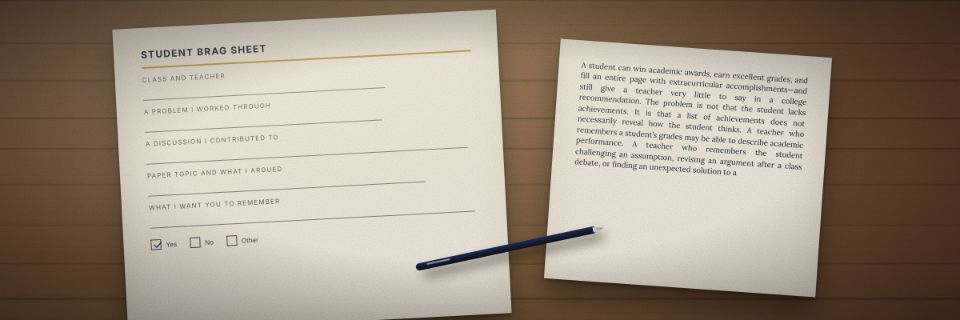
A student asks a favorite teacher for a college recommendation in September. The teacher agrees, but the application deadline is approaching, the school year is underway, and several other students have made similar requests. The student then sends a résumé and brag sheet containing dozens of activities, awards, and accomplishments.
The teacher now has the information—but limited time to review it, recall specific classroom experiences, and develop a thoughtful letter.
This situation is avoidable. One of the simplest ways to support a strong recommendation is to begin the process before senior-year deadlines become urgent. For many students applying to college in the fall, late spring of junior year is a sensible time to identify recommenders, ask respectfully, and begin preparing the information teachers may need.
However, timing alone cannot guarantee a stronger letter. A teacher who knows a student well and has meaningful observations may write an excellent recommendation even when the request comes later. The goal of early preparation is to make the process manageable, provide useful context, and give teachers an opportunity to decide whether they can write a thoughtful evaluation.
1. Why Late Spring of Junior Year Is a Useful Starting Point
Junior-year teachers are often well positioned to write recommendations because they have recently observed students in academic settings and can describe their work, intellectual development, and classroom contributions.
The College Board recommends asking teachers who know the student well, including junior-year or current teachers, and making requests well in advance of application deadlines. It also advises students to provide a résumé or brag sheet that makes relevant information easy to reference.
For students planning to apply in the fall of senior year, late spring offers several practical advantages:
The student can identify appropriate teachers before summer. This allows time to consider who has the strongest firsthand perspective, rather than selecting someone in a rush.
The teacher can decide whether to accept. A respectful early request gives the teacher room to decline if they do not feel able to write a strong letter or have too many commitments.
The student can prepare a useful summary. Activities, academic projects, responsibilities, and personal reflections can be organized before the application workload intensifies.
The process can be clarified before school closes. Students can ask whether the teacher prefers a questionnaire, résumé, brag sheet, or another format, and whether the school has a specific recommendation procedure.
The distinction is important: asking early does not mean expecting the teacher to write the letter immediately. It means beginning the relationship and planning process early enough to avoid unnecessary pressure later.
The College Board's recommendation-letter guidance supports early requests and preparation, but it does not prescribe one universal spring deadline. Students should follow their school's procedures and their teachers' preferences.
2. Ask Early, but Do Not Confuse Early Requests with Early Drafting
An early request gives a teacher time to consider the commitment. It does not mean the student should expect the teacher to reserve a specific number of hours, begin drafting in May, or promise a particular level of effort.
Teachers have different schedules and workflows. One may prefer to write recommendations during the summer; another may begin after receiving the school's official instructions in the fall. Some schools ask teachers to complete internal forms or follow a designated platform before students formally invite recommenders through the Common Application or another system.
The student's role is to make a timely, considerate request and ask what the teacher needs.
A respectful request might say:
“Thank you for teaching me this year. I learned a great deal in your class, especially during our work on [specific assignment or topic]. Would you feel comfortable writing a strong recommendation for my college applications this fall? I would be happy to provide a résumé or brag sheet, and I can follow whatever process is most convenient for you.”
This wording accomplishes three things. It identifies the relationship, asks rather than assumes, and gives the teacher an opportunity to decline.
Once the teacher agrees, the student should confirm the expected timeline and follow the school's instructions. If the teacher says to send materials in August or September, there is no reason to insist on delivering them months earlier.
The objective is to reduce the teacher's burden, not to create another obligation prematurely.
3. What a Brag Sheet Should Accomplish
A brag sheet is not a second college application. It is a concise source of context that helps a recommender remember the student's experiences, interests, and accomplishments.
The Common App provides separate brag-sheet resources for teachers, counselors, and families. Its teacher questionnaire asks students to share information that can help a teacher write a more personal and effective recommendation. The materials encourage specificity rather than a simple inventory of achievements.
A useful brag sheet should make it easier for the teacher to recall the student—not tell the teacher what conclusion to reach.
Consider including:
Relevant classroom experiences. Identify a paper, project, presentation, laboratory investigation, or discussion that was meaningful to the student. Briefly explain what the student worked on and why it mattered.
Academic development. Describe a challenge, a change in approach, or a skill the student developed. An example of responding to feedback may be more useful than a list of high grades.
Interests beyond the classroom. Include a few activities, responsibilities, jobs, or independent projects that help the teacher understand the student more fully, particularly if the teacher would not otherwise know about them.
Personal reflections. Explain what the student learned, what they remain curious about, or how an experience influenced their goals. These reflections provide context without requiring the teacher to adopt the student's interpretation.
Accurate details. Include dates, roles, and project descriptions where relevant. Keep the information factual and avoid inflated descriptions of accomplishments.
A good brag sheet is selective. It does not need to contain every award, every club, and every activity since ninth grade. The teacher should be able to locate relevant information quickly.
Source: Common App, Teacher Brag Sheet.
4. Why Sending the Brag Sheet Early Does Not Guarantee a Better Letter
Families sometimes treat recommendation letters as deliverables that can be optimized by providing more material sooner. But a teacher's ability to write a meaningful evaluation depends on more than the date a document arrives.
A teacher may know a student exceptionally well but have limited time during a particular week. Another may have ample time but only a few specific observations to share. A detailed brag sheet can help with recall, but it cannot substitute for firsthand knowledge.
Nor should families assume that teachers write letters in the order requests arrive or that early requests guarantee more attention. There is no universal admissions rule establishing such a relationship.
What early preparation can do is remove avoidable friction. A well-organized student who makes a timely request, supplies accurate information, and communicates clearly is easier to work with than one who sends fragmented materials immediately before a deadline.
That is a practical benefit—not a promise about the letter's eventual quality.
Students should also avoid repeatedly asking teachers whether they have started drafting. Unless a teacher requests additional information, the student should respect the teacher's process and focus on meeting the deadlines that have been communicated.
5. A Practical Recommendation Timeline
The following timeline works for many students applying in the fall of senior year. It should be adjusted to the school's policies, application plans, and individual teacher preferences.
Time
Student’s Task
Purpose
March – May of Junior Year
Identify potential recommenders and reflect on which teachers know the student's academic work well.
Choose based on firsthand knowledge, not prestige or grades alone.
May – June
Ask teachers whether they would feel comfortable writing a strong recommendation.
Give them time to consider the request before the summer.
Late Spring or Summer
Prepare a concise résumé or brag sheet, following the teacher's preferred process.
Supply accurate context without scripting the letter.
August – September of Senior Year
Follow the school's instructions, enter recommenders in the required system, and confirm application deadlines.
Make sure the formal request and submission process are complete.
Several Weeks Before the Earliest Deadline
Send a polite reminder if appropriate and ask whether any additional information is needed.
Help prevent deadline confusion without repeatedly interrupting the teacher.
After Submission
Thank the teacher and provide a brief update if appropriate.
Maintain a respectful relationship and acknowledge the work involved.
The timeline is a planning framework, not a universal rule. Some schools coordinate recommendations through a counselor or school platform, and some teachers establish their own deadlines. Early-action and early-decision applicants may have earlier submission dates, so their planning must account for those deadlines.
The Common App also explains that colleges set their own recommendation requirements. Students should check each institution's requirements and follow their school's process rather than assume every college uses the same system.
Sources: College Board: Tips for Letters of Recommendation and Common App: First-Year Application Guide.
6. How to Follow Up Without an No Ying the Teacher
Early planning only works when communication remains considerate. Students should not interpret a teacher's agreement as permission to send frequent status requests.
A practical approach is to establish the deadline and preferred communication method when the teacher accepts. Keep the materials organized, submit any required forms promptly, and send a brief reminder well before the earliest deadline if needed.
If the teacher has not provided a timeline, a concise message is appropriate:
“Thank you again for agreeing to write my recommendation. My earliest application deadline is [date]. Please let me know if there is any additional information I can provide or if another deadline would be helpful for your planning.”
Students should avoid asking to read the letter unless the teacher or school's procedure specifically calls for it. They should also avoid requesting changes simply because the letter does not match the language used elsewhere in the application. The recommendation should remain the teacher's independent assessment.
If a deadline is approaching and the recommendation has not been submitted, the student should follow the school's guidance for checking its status and, when appropriate, ask the counselor for help. A respectful follow-up is not the same as repeated pressure.
How Scholar Coach Helps Families Coordinate Recommendations
Scholar Coach helps families prepare the recommendation process early while respecting teachers' time and independence.
Build a recommendation calendar. We identify likely recommenders, school-specific procedures, and the earliest application deadlines so students can plan requests and follow-ups in advance.
Select appropriate teachers. We help students evaluate who has firsthand knowledge of their academic work, intellectual curiosity, development, and classroom contributions.
Prepare focused brag sheets. We organize relevant projects, experiences, accomplishments, and reflections into concise materials that help teachers recall useful context without dictating what to write.
Coordinate communication. We help students make respectful requests, provide materials in the preferred format, and follow up appropriately as deadlines approach.
Check application requirements. We review college-specific recommendation requirements and the school's submission process so that students do not assume every institution follows the same rules.
The purpose of early planning is not to secure a teacher's attention before other students do. It is to make the process thoughtful, organized, and respectful. Give teachers time to decide, provide information they can actually use, and leave the evaluation in their hands. That is a stronger strategy than trying to engineer a recommendation through timing alone.